Orgonite pyramids sit on desks, windowsills and altars everywhere, glinting with metal flecks and a crystal inside. The story behind them is older and stranger than most shop listings let on.
Where orgone comes from: Wilhelm Reich
The word "orgonite" grows out of "orgone," a term coined by the Austrian psychiatrist and psychoanalyst Wilhelm Reich (1897 to 1957). According to Encyclopaedia Britannica, Reich was a student of Sigmund Freud and taught at the Vienna Psychoanalytic Institute before his ideas took him in a very different direction. He came to describe orgone as a life energy present throughout nature, carried by tiny units he called "bions."
Wikipedia's article on orgone notes that Reich first proposed the idea in the 1930s, and that he founded the Orgone Institute around 1942, after moving to the United States in 1939. His most famous invention was the orgone energy accumulator, often called the orgone box: a cabinet built from alternating layers of organic and metallic materials that a person could sit inside. Reich believed the layering gathered orgone from the surrounding air. That layering of organic and metal is the direct ancestor of every orgonite pyramid sold today.
Mainstream science never accepted orgone as a measurable energy, and Wikipedia describes the concept as pseudoscientific. Reich's admirers still regard him as an original thinker. Both views are part of the honest history.
The FDA case against Reich
Reich's story took a hard turn in the 1950s. Britannica records that the U.S. Food and Drug Administration opened an investigation into his work in 1947. According to Wikipedia's biography of Reich, the United States Attorney for the District of Maine filed a complaint in February 1954 under the Federal Food, Drug, and Cosmetic Act, seeking to stop interstate shipment of orgone accumulators and the literature that promoted them. The FDA's position was that the devices were being marketed with false and misleading medical claims.
Reich refused to appear in court, writing to the judge that no court could pass judgment on his science. As NBC News and Wikipedia both report, that refusal led to a default judgment in March 1954, with orders that his accumulators be destroyed and several of his books withheld.
- 1956: After an associate shipped accumulators across state lines in violation of the order, Reich was charged with contempt of court and sentenced to two years in prison. Wikipedia notes that more than six tons of his publications were burned that summer by court order.
- 1957: According to NBC News, Reich died of a heart attack on November 3, 1957, in the federal prison at Lewisburg, Pennsylvania, having served about eight months.
- 1960: His estate near Rangeley, Maine, which he named Orgonon, opened as the Wilhelm Reich Museum, as he had requested in his will (NBC News).
The book burning is still debated: some see a necessary response to a man defying a court, others a heavy-handed act against ideas.
From orgone boxes to orgonite
Reich himself never made orgonite. According to Herbs Etc, quoting the maker Gracefull Heart, the Austrian Karl Hans Welz began casting metal particles in resin in 1991, building on the accumulator's organic-plus-metal idea. A history published by the maker True Orgonite notes that Don Croft's own writing credits Welz with the word "orgonite."
The version most people recognize came next. As Herbs Etc and True Orgonite both describe, Don and Carol Croft popularized a simple recipe in the early 2000s: resin, coarse metal shavings and a small quartz crystal, cast in a mold. They encouraged people to make pieces at home and give them away, a practice still called "gifting." The pyramid became one popular form alongside discs, cones and pendants.
How orgonite and orgone pyramids are made
The resin
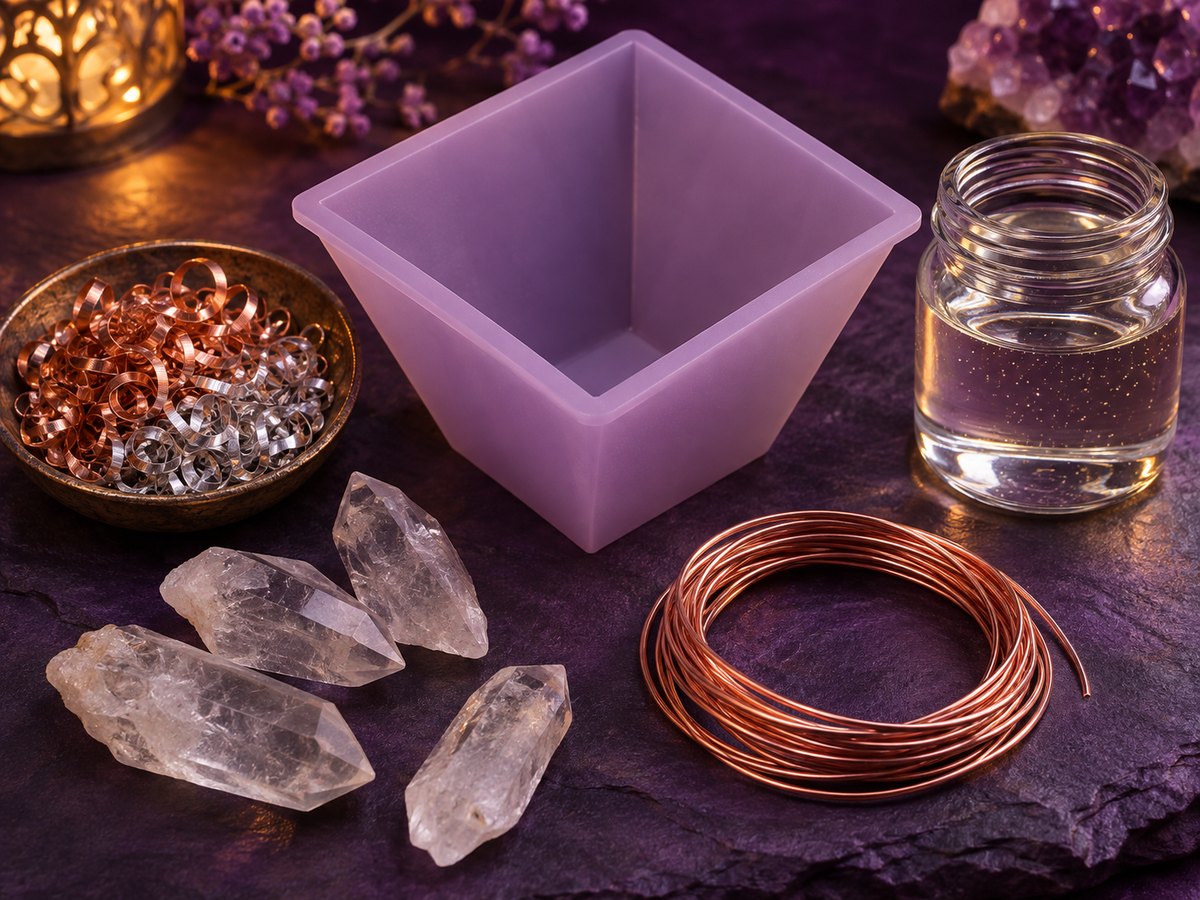
Resin is the "organic" half of the formula. Makers use epoxy or polyester casting resin: two liquids that harden into a solid once mixed. Clear resin shows off the metal and crystal; tinted resin gives a smoky look.
The metal
Metal shavings or filings are the "inorganic" half. Copper, brass, aluminum, bronze and steel are all common, often collected as offcuts from machine shops.
The quartz and extras
A clear quartz point is the Croft-era signature, usually set near the center or capstone. Many makers add other stones, copper wire coils or metal leaf.
The pour
The metal and crystal are layered into a silicone pyramid mold, resin is poured over them, and the piece hardens fully before it is unmolded and polished.
A safety note if you make your own: according to the resin maker Entropy Resins, skin contact is the most common way people are exposed to liquid resin and hardener. Craft Resin's guide adds that liquid resin can irritate skin and, with repeated exposure, trigger allergic skin reactions in some people. Both recommend nitrile gloves, eye protection, good ventilation, and letting the piece harden completely before any sanding. Entropy notes that a full set can take more than two weeks at room temperature, even when the piece already feels solid. Keep supplies away from children and pets, and if you are pregnant, ask your doctor before working with resin.
What people say they use orgonite for
Owners describe a range of reasons, all rooted in belief rather than measurement:
- A sense of balance in a space. Many feel a piece makes a room feel calmer or "clearer."
- A meditation anchor. Practitioners often set one on an altar as a focus for quiet sitting.
- Near electronics. Placing a small piece beside a router, computer or phone charger is a long-running custom in the orgonite community.
- Gifting and intention. In the Croft tradition, giving a piece away is a small act of goodwill.
- Simply beauty. Plenty of owners just love the look.
None of these uses has scientific backing. Think of an orgonite pyramid like a crystal or a singing bowl: a meaningful object you enjoy, never a stand-in for a doctor's care.
How to choose a well-made orgonite pyramid
Quality ranges from mass-produced trinkets to carefully layered handmade pieces. Look at:
- Metal density. Look for a generous, even fill of shavings rather than a sprinkle of glitter floating in resin.
- A real crystal. The quartz should be a visible stone, not a plastic bead.
- Clean casting. Check for sharp, even edges, a flat base that does not rock, and a smooth surface. A few tiny bubbles are normal; cracks or a sticky surface are not.
- Clear materials list. A good maker tells you which resin, metals and stones went in and where the piece was made.
- Honest language. Be wary of any listing that promises results for your body. The FDA history shows where that marketing can lead.
Larger handmade and gallery-grade pieces, like the orgonite pyramids and sacred-geometry harmonizers from iPyramids, sit at the collector end; you can browse them in our harmonizers and sacred geometry section.
Placement ideas and care
Where people like to place them
- On a meditation altar or a shelf you see each morning.
- On a desk beside a computer, or near a Wi-Fi router.
- On a bedside table, a quiet spot many people like for reflection at the end of the day.
- In a garden bed or potted plant, a favorite custom among gifting enthusiasts.
Keeping it beautiful
Orgonite is low-maintenance, but resin has a few quirks. According to Mill Lane Studio, exposure to UV light and excess heat are among the main reasons resin yellows over time, so keep your pyramid out of strong, direct sunlight if you want it to stay clear. Dust it with a soft cloth, slightly damp if needed, and dry it straight away. Skip harsh cleaners, alcohol, abrasive pads, dishwashers and hot cars.
Many owners also "cleanse" a piece the way they would a crystal: moonlight, the sound of a singing bowl, or a fresh intention.
Whatever you believe about orgone, an orgonite pyramid carries a remarkable history: a Viennese psychiatrist, a federal court case, a museum in the Maine woods, and makers casting resin at their kitchen tables.
Quick answers
What is orgonite?
Orgonite is a handmade composite of resin, metal shavings and usually a quartz crystal, cast in a mold. It is inspired by Wilhelm Reich's 1930s idea of orgone, a life energy he believed could be gathered by layering organic and metal materials. The modern resin recipe was popularized by Don and Carol Croft in the early 2000s.
Who invented orgonite?
Wilhelm Reich coined the word orgone but never made orgonite. Karl Hans Welz began casting metal in resin around 1991, and Don Croft credited him with the term. Don and Carol Croft then popularized the resin, metal and quartz version most people know today.
Why did the FDA go after Wilhelm Reich?
In 1954 the FDA obtained a federal injunction stopping interstate shipment of Reich's orgone accumulators and related literature, saying they were promoted with false medical claims. Reich refused to appear in court, was later convicted of contempt, and died in federal prison in 1957.
How do I clean an orgonite pyramid?
Wipe it with a soft dry or slightly damp cloth and dry it right away. Avoid harsh cleaners, alcohol, abrasives and dishwashers, and keep it out of strong direct sunlight and heat, which can yellow resin over time.