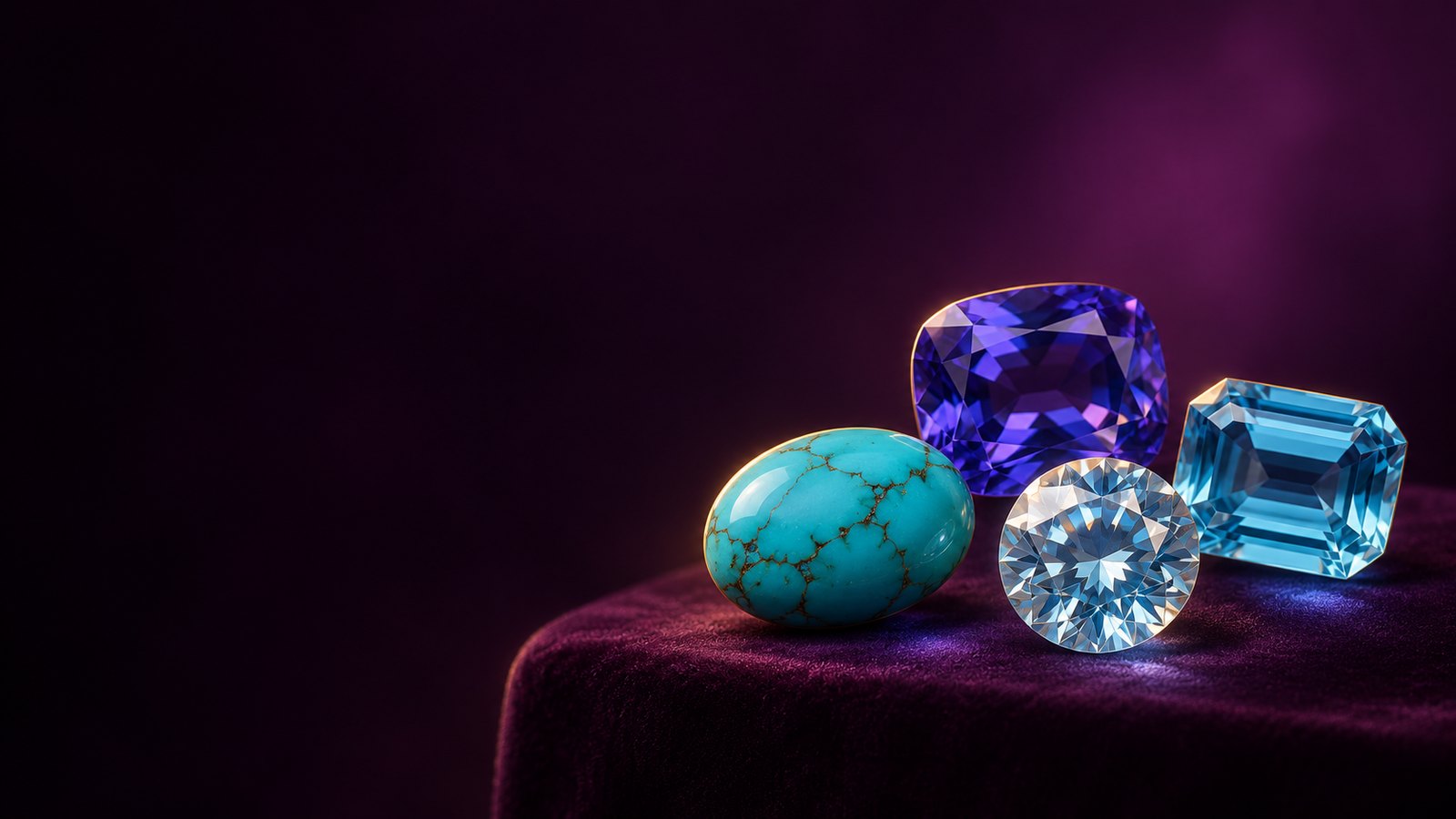
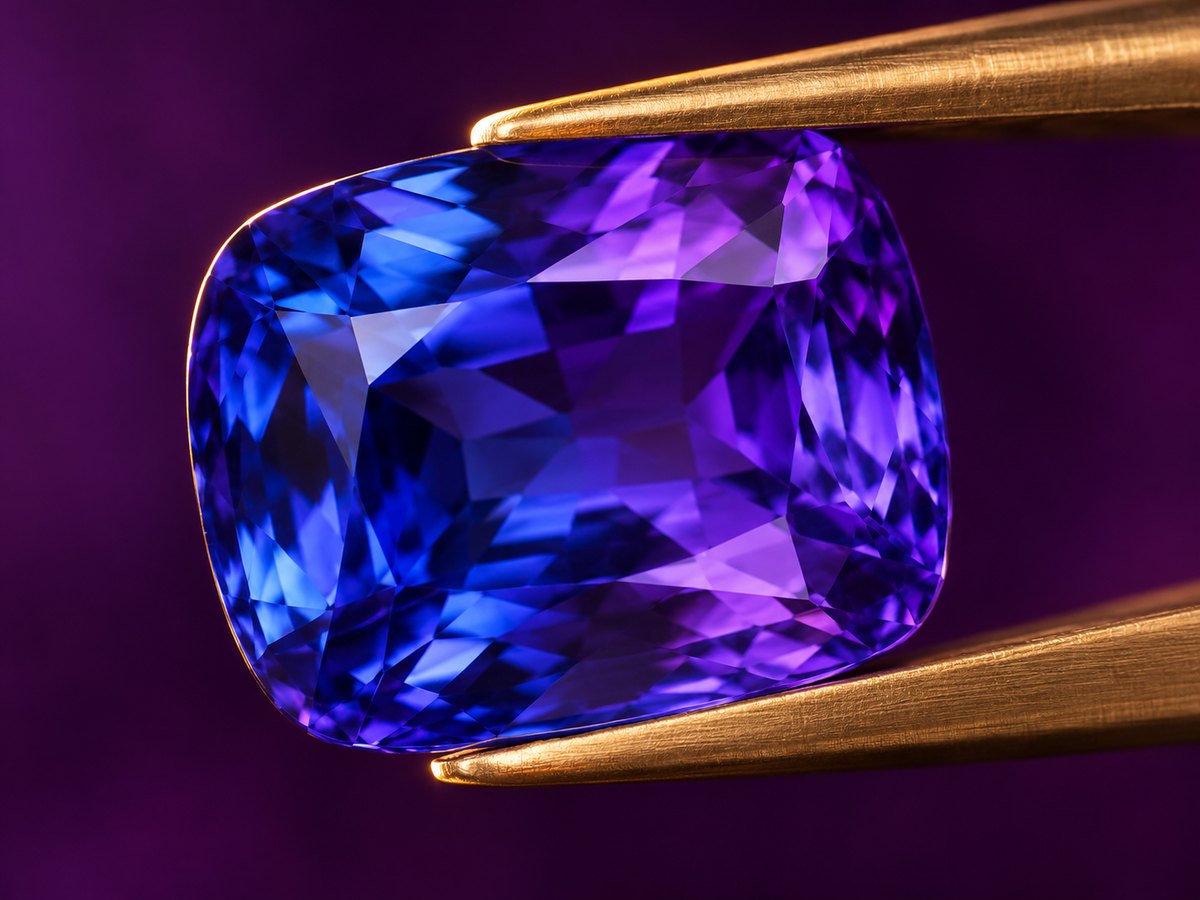
December is the one month that gets a whole palette of blue. Depending on whose list you read, the December birthstone can be turquoise, tanzanite, zircon or blue topaz. Each is a different mineral with its own story, its own weak spots and its own common fakes. With the holidays a few weeks away, here is how to tell them apart, how to spot an imitation, and how to pick the right one as a gift.
What is the December birthstone? The official lists
The modern US list started in 1912. According to Jewelers of America, the list was set that year by the American National Retail Jewelers Association, the group that became today's Jewelers of America. Its current list gives December three stones: turquoise, blue topaz and tanzanite.
The GIA (Gemological Institute of America) and the American Gem Society both describe December's birthstones as tanzanite, zircon and turquoise. GIA's own tanzanite page goes further and names all four, saying tanzanite is a birthstone for December "along with zircon, turquoise, and blue topaz." So there is no single wrong answer. Turquoise is the old classic, tanzanite is the newcomer, and zircon and blue topaz round out the set. Our birthstones by month guide covers the rest of the calendar.
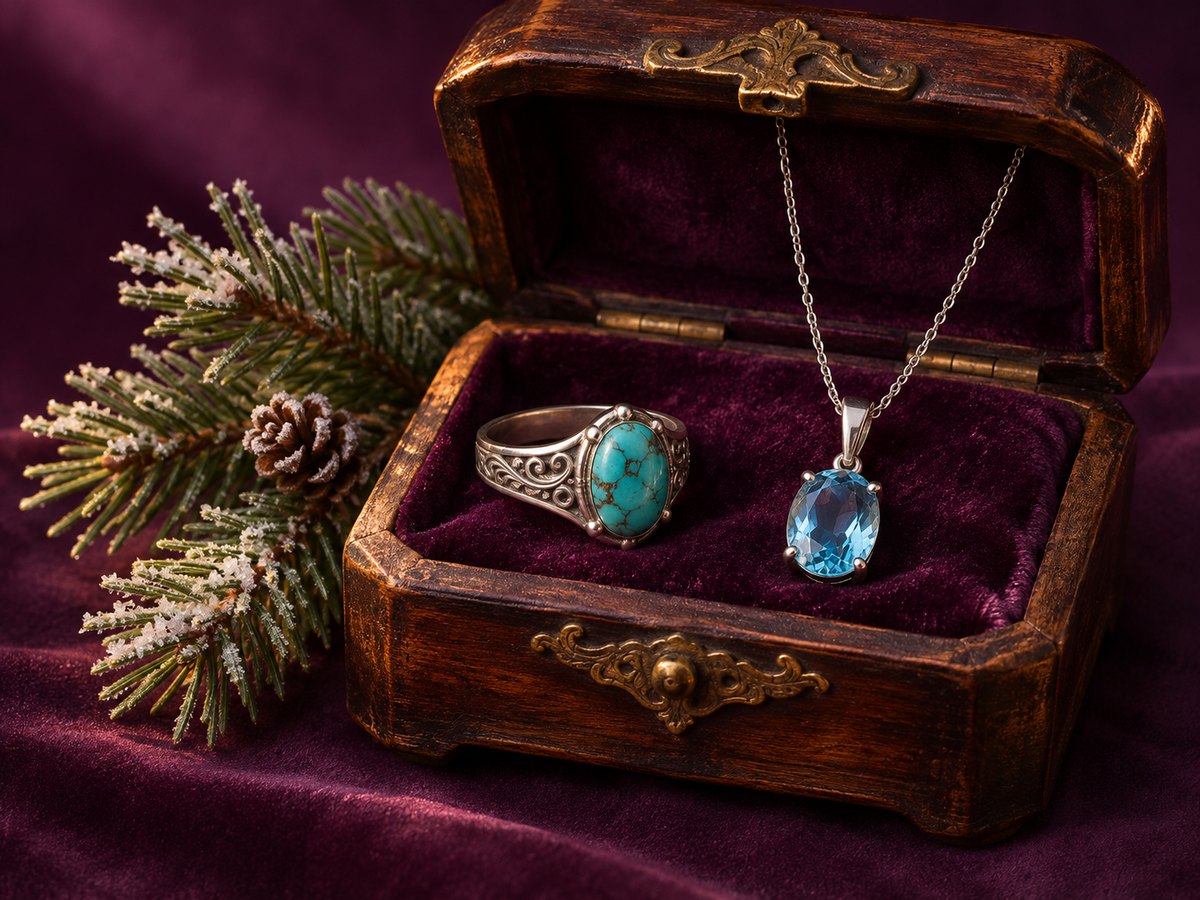
Turquoise: the classic December birthstone
Turquoise is a mineral, not a glass or a dye. According to GIA, it forms in dry regions where acidic, copper-rich groundwater seeps down and reacts with rock containing phosphorus and aluminum. The result is a porous, opaque, hydrated copper and aluminum phosphate. Mindat gives its formula as CuAl6(PO4)4(OH)8 · 4H2O and its hardness as 5 to 6 on the Mohs scale, softer than quartz.
The dark veins you often see are called matrix. GIA explains that they are leftover host rock: iron-rich limonite leaves dark brown markings, and sandstone leaves tan ones. Matrix is natural and many people love it.
Turquoise has one of the longest histories of any gem. GIA notes that it was buried in ancient Egyptian tombs, that Chinese artisans carved it more than 3,000 years ago, and that it has been mined in the Nishapur district of Iran for more than 1,000 years. That region's even, intense color gave the trade the term "Persian blue," which is now used for that shade wherever the stone was mined. In the US, GIA says most production today comes from Arizona and Nevada, and China is now the world's largest producer.
Turquoise in tradition
The lore is rich. According to GIA, people from the 13th century on believed turquoise protected the wearer from falling, especially off horses. In European tradition a turquoise ring meant "forget me not," and in Tibet it is considered a national treasure. In modern crystal practice, many people link turquoise with the throat chakra and with honest, clear speech, and it is often given to Sagittarius. These are beliefs and symbols, and that is how we hold them here.
Tanzanite, zircon and blue topaz
Tanzanite
Tanzanite is a blue to violet variety of the mineral zoisite. GIA reports that the Merelani Hills of northern Tanzania are the only place on earth where it is mined commercially, and that the stones were identified in 1962, with the main source found in 1967. It is also pleochroic: tilt it and you see different colors in different directions. GIA notes that most tanzanite starts out brownish and is heat treated to bring out the blue to violet, and that this color is permanent. It rates 6 to 7 in hardness and abrades easily, so GIA suggests earrings and pendants rather than an everyday ring.
Zircon
Zircon is a natural zirconium silicate, and it is not the same thing as cubic zirconia, the lab-made diamond look-alike. The American Gem Society calls zircon an underrated gem that is often confused with cubic zirconia because of the similar names. GIA describes its brilliance and "fire," the flashes of rainbow light that caused centuries of confusion with diamond, and notes that zircon found in Australia is the oldest mineral known on earth, about 4.4 billion years old. Blue zircon is usually heat treated, and GIA warns that some treated stones can drift back toward light brown after long exposure to bright light.
Blue topaz
Blue topaz is the hardest of the four at 8 on the Mohs scale, according to GIA. It is also the most openly treated. GIA says blue topaz is "hardly ever natural": colorless topaz is plentiful and is irradiated and heated to create the familiar sky, Swiss and London blues. That is a standard, stable treatment, and it is why blue topaz is so affordable.
How to tell real turquoise from an imitation
Turquoise is the December stone most often faked, and the usual stand-in is not plastic. It is dyed howlite or dyed magnesite, two cheap white minerals. Geology.com explains that both often have gray veining that looks like turquoise's spiderweb matrix, and that once dyed blue they fool many buyers. A GIA review of infrared testing in Gems & Gemology (Winter 2024) also lists howlite and magnesite as common dyed imitations.
- Be wary of perfect color. Geology.com advises caution with turquoise that is a "wonderfully blue and very uniform color." Natural turquoise usually varies a little.
- Look in the cracks and drill holes. Dye tends to collect in pits, cracks and around bead holes, leaving darker blue lines.
- Check a chip or the back. Geology.com notes that dye often does not penetrate deeply, so a scratch on the back of a stone can reveal a white interior. Only do this on a piece you own and are willing to mark.
- Ask about treatment. According to GIA, a lot of real turquoise is dyed or stabilized with epoxy or acrylic resin to improve its color and durability. That is still turquoise, but it should be disclosed. A seller should be able to tell you whether a piece is natural, stabilized, reconstituted or an imitation.
- Get proof for valuable pieces. A gemologist can separate turquoise from howlite and magnesite with a refractometer or infrared testing, which is how labs settle it.
For the other three stones, the main traps are names. Cubic zirconia is not zircon, and "tanzanite-colored" glass or crystal is not tanzanite. A clear receipt that names the mineral is your friend.
Caring for December birthstones
All four like the same gentle routine: warm water, a drop of mild soap and a soft brush or cloth. GIA advises against steam and ultrasonic cleaners for turquoise, tanzanite and zircon. Beyond that, each stone has one thing to watch:
- Turquoise: it is porous. GIA warns that it can be discolored by chemicals, cosmetics, perfume and even skin oils, and that rings and beads may slowly darken as they absorb oils. Put it on last, after lotion and perfume, and never soak it.
- Tanzanite: it can crack with sudden temperature changes, so keep it away from heat and don't run it from hot water into cold.
- Zircon: it can wear at the facet edges. GIA suggests taking it off for gardening, sports and washing dishes.
- Blue topaz: at 8 on the Mohs scale it can scratch softer stones such as turquoise, so store it in its own pouch or compartment.
If you use crystals in cleansing rituals, choose moonlight, sound or smoke rather than water for turquoise. Our guide to cleansing and caring for crystals walks through the gentler methods.
December birthstone gift ideas
- A turquoise pendant or earrings for someone who loves history and earthy color. Pendants avoid most of the knocks and lotion a ring would see.
- Tanzanite earrings for a special-occasion gift with a rare story: one source, one small region of Tanzania.
- A blue topaz ring for everyday wear, thanks to its hardness.
- A blue zircon piece for the person who loves sparkle and wants something different from diamond.
- A raw or tumbled turquoise stone for an altar or desk, as an affordable first birthstone.
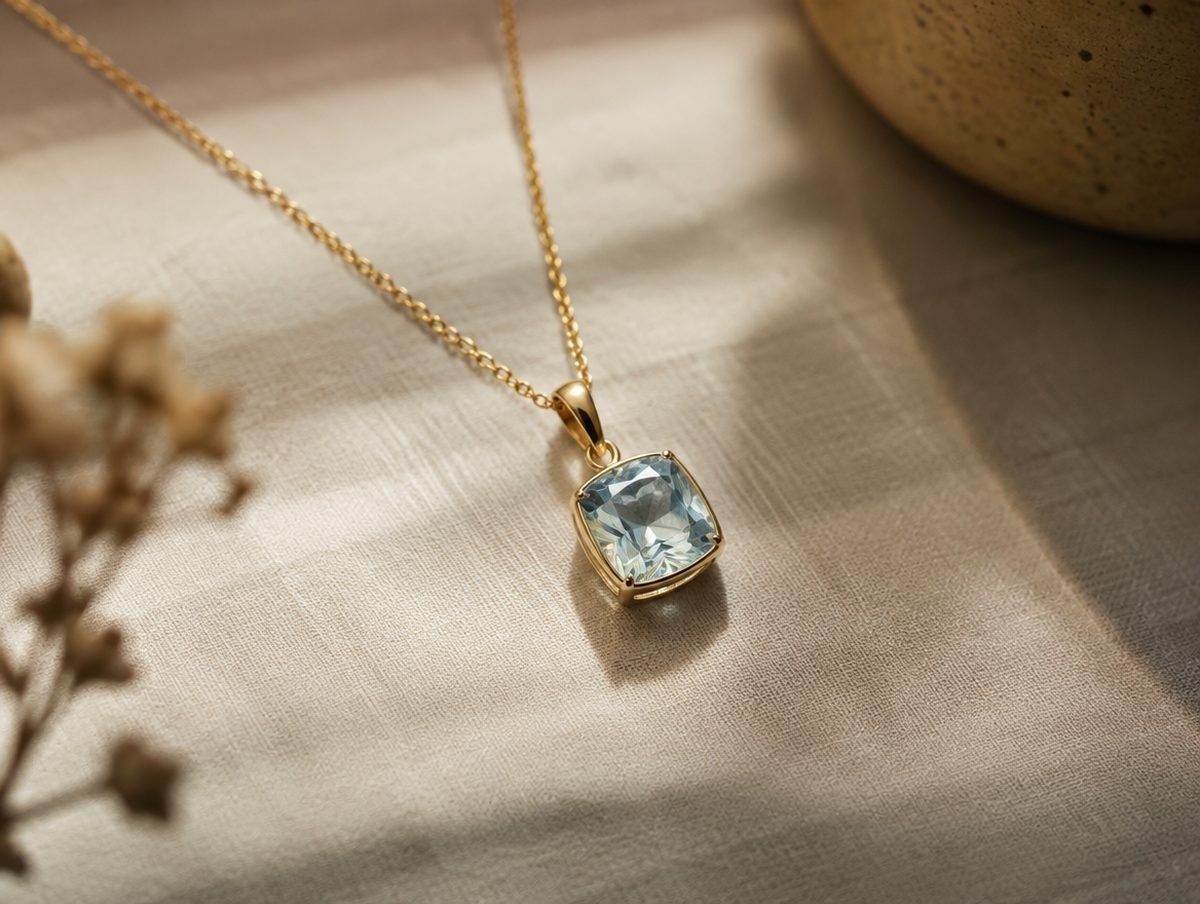
- A crystal keepsake such as the iTorus iZ pendants from iPyramids, which pair crystal with gold geometry, for the person who already has a jewelry box full of birthstones.
Whatever you choose, add a small card naming the stone and how to care for it. It turns a pretty gift into a thoughtful one.
Quick answers
What is the December birthstone?
There are several. GIA and the American Gem Society list turquoise, tanzanite and zircon. Jewelers of America, which started the US list in 1912, lists turquoise, blue topaz and tanzanite, and GIA also recognizes blue topaz for December. Choose whichever color, story and budget suit the person.
How can I tell if my turquoise is real?
Be cautious of very even, bright blue color and of dye pooled in cracks or bead holes. The most common imitations are dyed howlite and dyed magnesite, which can show a white interior where the dye did not reach. For a valuable piece, ask a gemologist, who can confirm it with a refractometer or infrared testing.
Can turquoise get wet?
A quick wipe with warm, soapy water is fine, but don't soak it. Turquoise is porous and can absorb water, soaps, lotions and skin oils, which may change its color. Dry it right away and keep it away from steam and ultrasonic cleaners.
Is zircon the same as cubic zirconia?
No. Zircon is a natural mineral, zirconium silicate, mined in places such as Sri Lanka and Australia. Cubic zirconia is a lab-made material used as a diamond look-alike. The names are similar, but they are different materials.