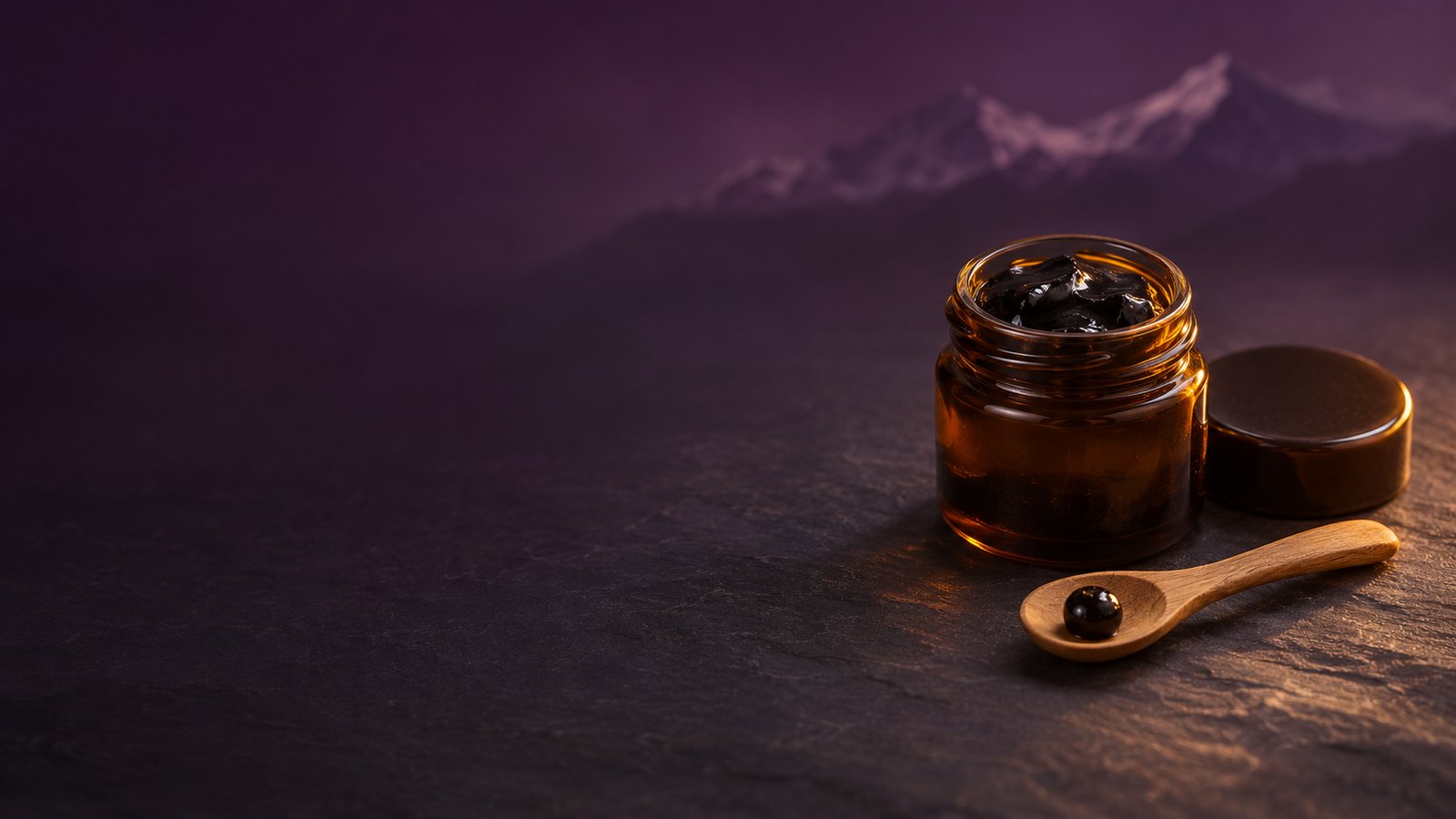
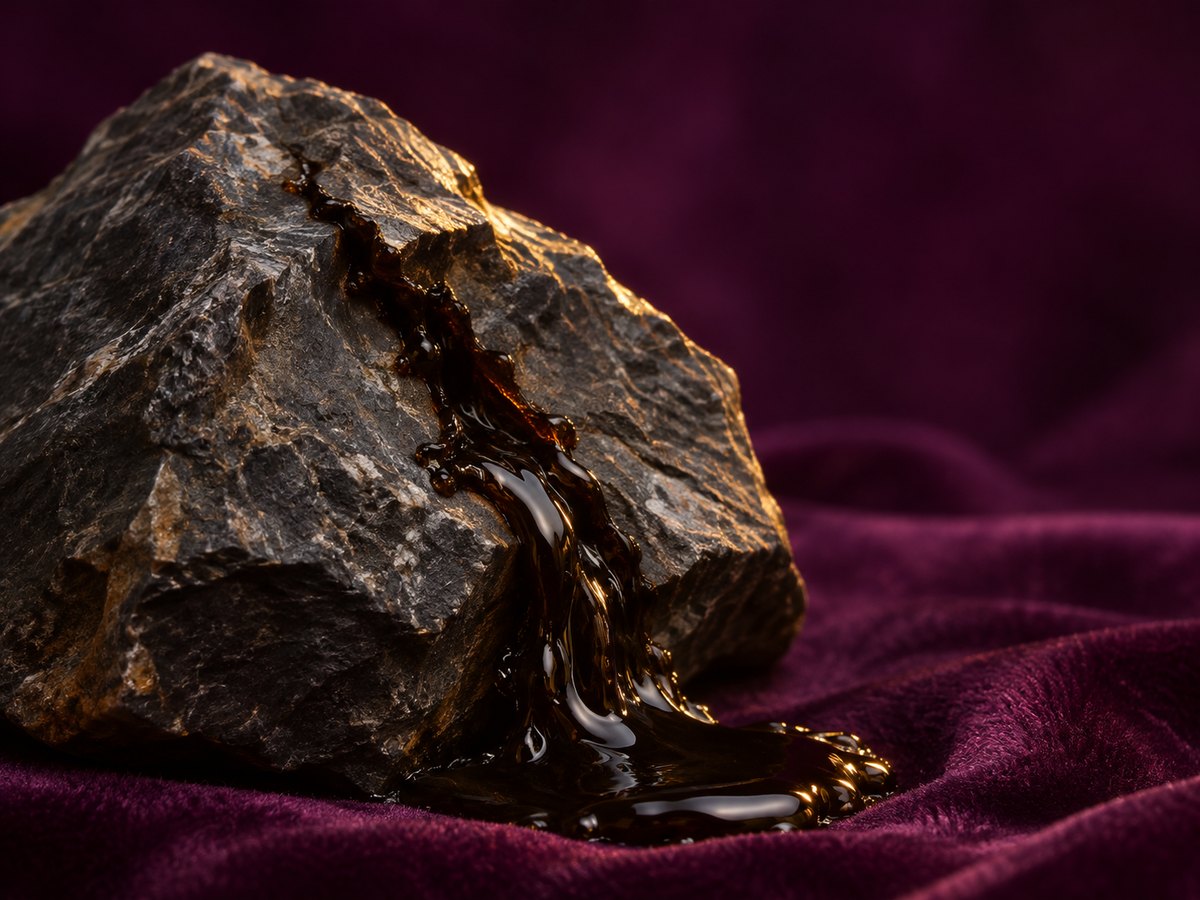
Shilajit is one of those things that looks almost too strange to be real: a glossy, near-black resin that comes out of mountain rock. Interest in Himalayan shilajit has grown quickly, and so has the number of jars, drops and powders for sale. Some of them are carefully purified and tested. Some are not.
This guide covers what shilajit is, where it comes from, its forms, and how to buy and store it safely.
What shilajit actually is
According to Encyclopaedia Britannica, shilajit is a sticky, tar-like substance formed from the slow decomposition of plant matter and other organic material, which becomes compressed and preserved under layers of rock. It is also known as mumijo, mumiyo or mineral tar.
A scientific review archived on PubMed Central, the U.S. National Library of Medicine's research archive, describes shilajit as a blackish-brown powder or an exudate from high mountain rocks. The same review says it is made up mainly of humic substances, including fulvic acid, which together account for around 60% to 80% of the material. These form as microorganisms break down plant material over a very long time. It also notes that shilajit's makeup varies from region to region.
Where it comes from
Britannica says shilajit is found in rock fissures mainly in the Himalayas, the Altai Mountains, the Caucasus and the mountains of the Gilgit-Baltistan region of Pakistan, at altitudes between roughly 1,000 and 5,000 meters, where it seeps from crevices in warm weather. The PubMed Central review adds that it has also been found in Russia, Tibet and Afghanistan, and in northern Chile, where it is called Andean shilajit.
When a label says "Himalayan shilajit," it is naming a region, usually Nepal, India or Pakistan. When it says "pure Himalayan shilajit," that is a marketing phrase, not a grade or a certification. Only lab testing tells you what is in the jar.
Its place in Ayurvedic tradition
Shilajit has a long history in Ayurveda, the traditional system that grew up in India. The PubMed Central review notes that it has been known and used in Ayurvedic practice for centuries, under names such as shilajatu and salajit.
The forms it comes in
Raw shilajit-bearing rock is not something you eat. It has to be cleaned and processed first. What reaches the shelf usually comes in one of three forms:
- Resin. The most traditional form: a dense, sticky paste sold in a small jar, often with a tiny spoon. A guide from the Danish retailer CBDanmark points out that resin lets you see and smell what you are buying, but it is sticky, hardens in cool rooms, softens in heat, and is hard to portion evenly by eye at first.
- Liquid drops. Resin dissolved into a liquid and sold in a dropper bottle. Easier to measure; check what else is in the bottle.
- Powder and capsules. Dried extract, sometimes blended with other ingredients. Banner Health dietitian Tiffone Powers-Parker notes that most products do not say how much fulvic acid they contain, and that extracts and resins can differ a great deal in concentration.
No form is automatically safer. A tested batch beats a beautiful jar with no paperwork.
Why purity matters more than anything else
Because shilajit forms in rock, it can carry whatever is in that rock. The PubMed Central review states plainly that shilajit taken without proper purification may carry mycotoxins (toxins from molds), heavy metal ions and other unwanted compounds, and that only purified, ready-to-use preparations should be consumed.
A review indexed on PubMed, titled "Hazardous or Advantageous", gathered published data on shilajit's metal content. It reported that shilajit can contain around 65 metals, including toxic ones such as lead, arsenic, cadmium and mercury. Most measured levels fell below the limits set for herbal products, but some studies found levels above them, and the authors concluded that consuming shilajit without knowing its metal levels is not safe. Britannica adds that even products sold as "purified" have frequently been found to contain arsenic, lead and mercury.
The wider Ayurvedic product market has the same problem. The National Center for Complementary and Integrative Health (NCCIH), part of the U.S. National Institutes of Health, warns that some Ayurvedic preparations may contain lead, mercury or arsenic in amounts that can be toxic. A 2008 study in JAMA tested 193 Ayurvedic products bought online and found that about one in five contained lead, mercury or arsenic, every one of those exceeded at least one standard for acceptable daily intake, and 75% of the metal-containing products claimed to follow Good Manufacturing Practices. A reassuring label is not proof.
How to buy shilajit safely
The NIH Office of Dietary Supplements explains that supplements, unlike medicines, do not need FDA approval before they are sold. Here is a simple checklist.
1. Look for third-party lab testing
"Third-party" means the testing was done by an independent lab, not by the company selling the product. The Office of Dietary Supplements names ConsumerLab.com, NSF International and U.S. Pharmacopeia as organizations that offer quality testing, and notes that their seals show a product was properly made, contains what the label lists and does not contain harmful levels of contaminants. It adds that a seal is not a promise of safety or effectiveness.
2. Ask for the certificate of analysis
A certificate of analysis (COA) is a lab report for one specific production batch. A good seller will post it or send it on request. Ask any seller, Lajit included, for a current COA that matches your batch before you buy. According to The Longevity Store's guide to supplement testing, a useful COA shows:
- the testing lab's name and accreditation details
- the product name and the batch or lot number, which should match the number printed on your jar
- the date of analysis, so you know it is current and not an old, generic report
- each test performed and the method used
- actual numbers, not just the word "PASS," compared against a stated safety limit
3. Read the four heavy-metal results
Find the heavy-metal section and look for these four lines: lead, arsenic, mercury and cadmium. Each should show a measured number with units (usually parts per million or micrograms per gram) next to the limit it was compared against. For reference, the "Hazardous or Advantageous" review lists WHO and FDA limits for herbal drugs of 10 ppm for lead and arsenic, 1 ppm for mercury, and 0.2 to 0.3 ppm for cadmium. If any of the four is missing, or the report cannot be matched to your batch, keep shopping.
4. Small signals that help
- A clear region of origin and a note on how it was purified.
- A short ingredient list. With resin, it should be shilajit alone.
- A clearly printed lot number and sealed packaging.
If you are browsing, our iPyramids pantry picks include a Himalayan shilajit offered as resin or drops. Whatever you buy, from iPyramids or anyone else, ask for the current batch's COA before you open the jar.
How people traditionally take it
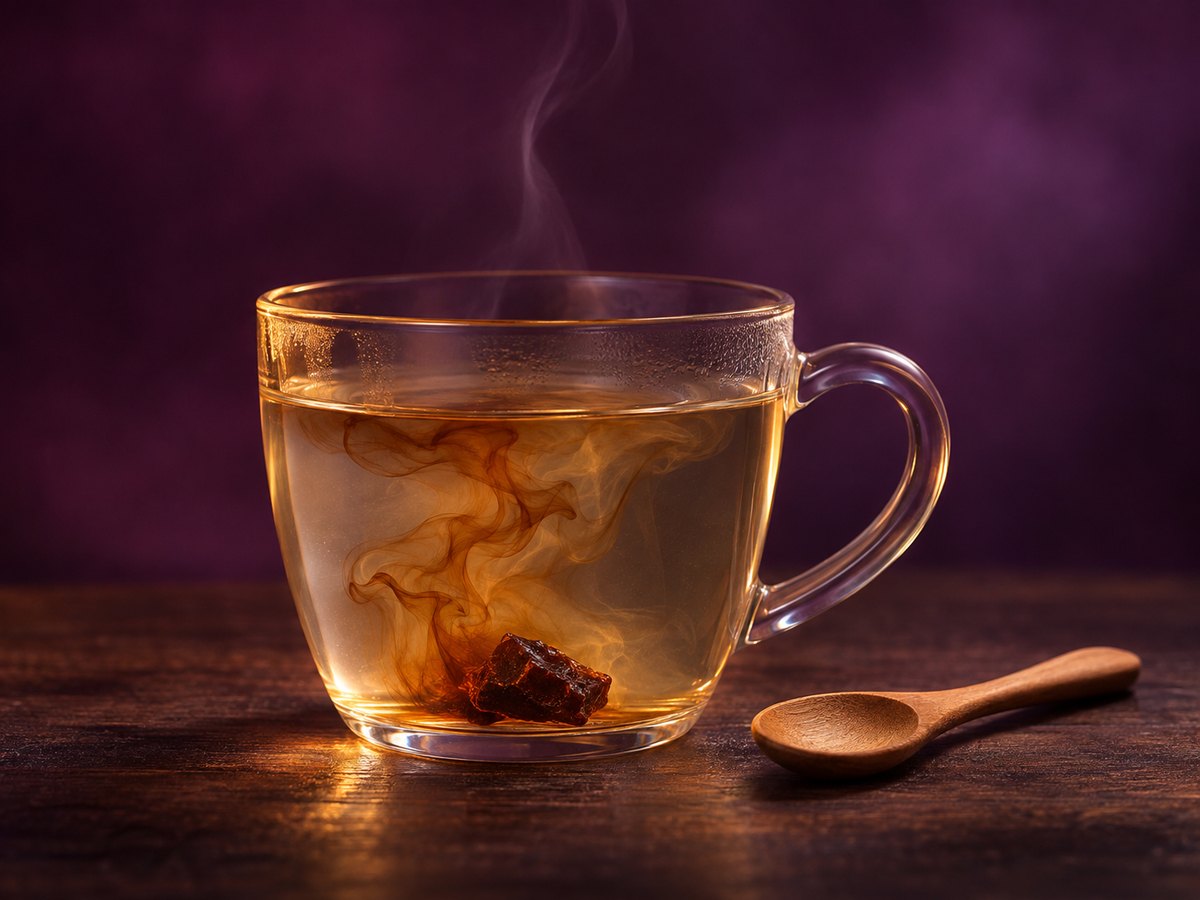
The traditional way to take resin is simple. Usage directions from sellers such as the Indian retailer PureMart describe a pea-sized amount dissolved in warm water or milk. The CBDanmark guide adds that the liquid should be warm, not boiling, and that well-purified resin should dissolve almost completely, without leaving a gritty layer of sand at the bottom of the cup. A lot of sediment can be a sign of poor purification.
Follow your own product's label and do not go beyond it.
Talk to your doctor first
Talk to your doctor before taking shilajit or any supplement, especially if you are pregnant or nursing, take any medication, or have a health condition. NCCIH also advises people who are pregnant or nursing to consult their health care provider before using Ayurvedic products. Bring the jar and its COA along.
How to store shilajit
The CBDanmark guide suggests a few simple habits:
- Keep it dry. Always use a clean, dry spoon. Moisture is the main enemy.
- Close the lid tightly after every use.
- Store it somewhere dark at room temperature or a little cooler, away from windowsills and direct sun.
- Skip the refrigerator for resin. Cold makes it so hard that it becomes almost impossible to portion.
Resin firms up in a cool room and softens in a warm one. That is normal.
Quick answers
What is shilajit made of?
Shilajit forms from plant matter that slowly decomposes and is compressed under layers of rock. A review on PubMed Central says it is made up mainly of humic substances, including fulvic acid, and that its makeup varies from region to region.
Is Himalayan shilajit different from Altai shilajit?
Both are the same kind of mountain resin, named for where they were collected. Britannica lists the Himalayas, the Altai Mountains, the Caucasus and the Gilgit-Baltistan mountains as the main sources. Because composition varies by region and batch, the lab report matters more than the place name.
How do I know if shilajit is safe to buy?
Ask for a current certificate of analysis from an independent lab that matches the lot number on your jar. Check that it shows measured results for lead, arsenic, mercury and cadmium next to their limits. If any of those are missing, choose another product.
How should I store shilajit resin?
Keep the jar tightly closed in a dark, dry place at room temperature or a little cooler, away from direct sun. Use a clean, dry spoon each time, and skip the refrigerator, which makes resin too hard to portion.