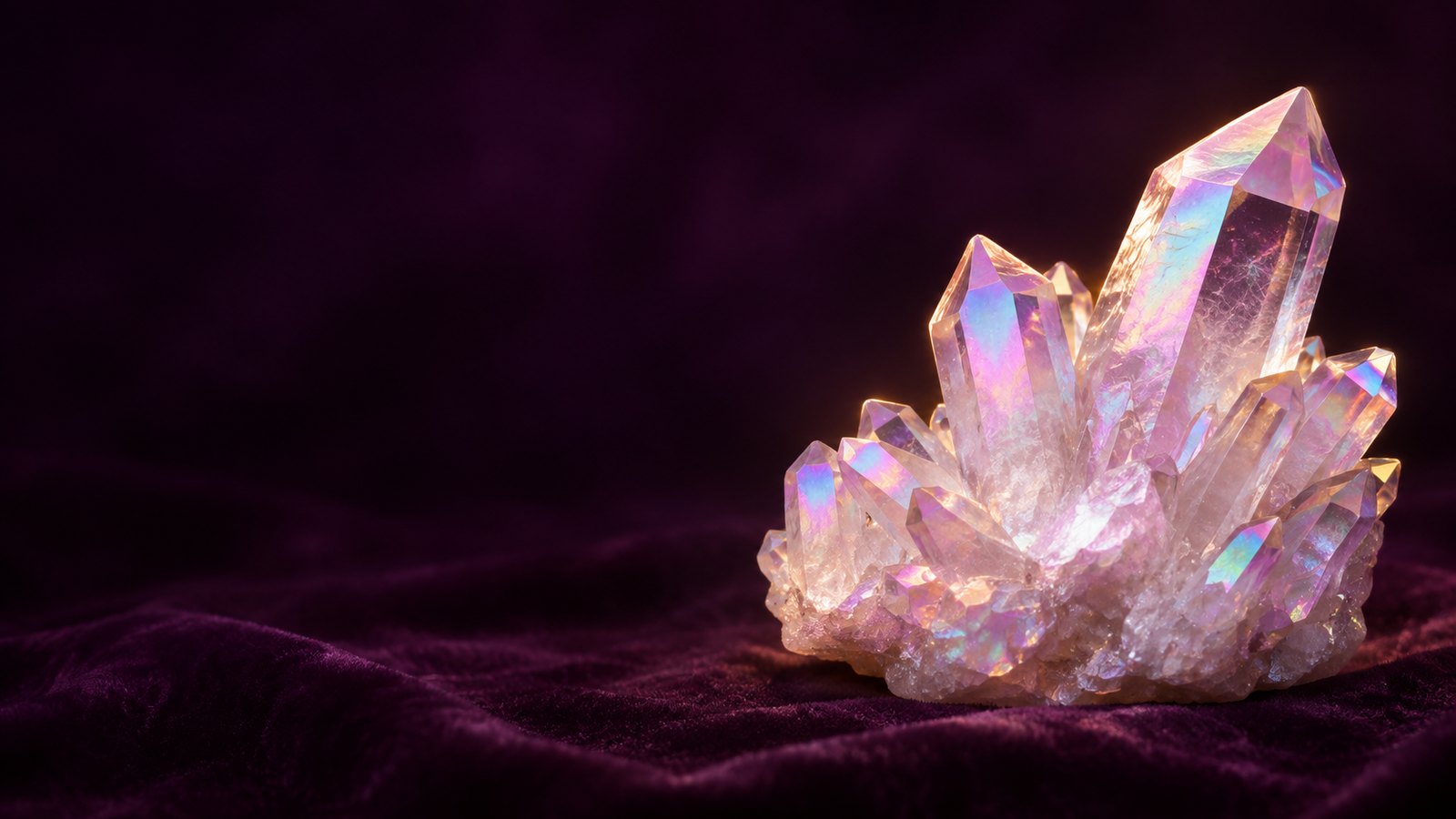
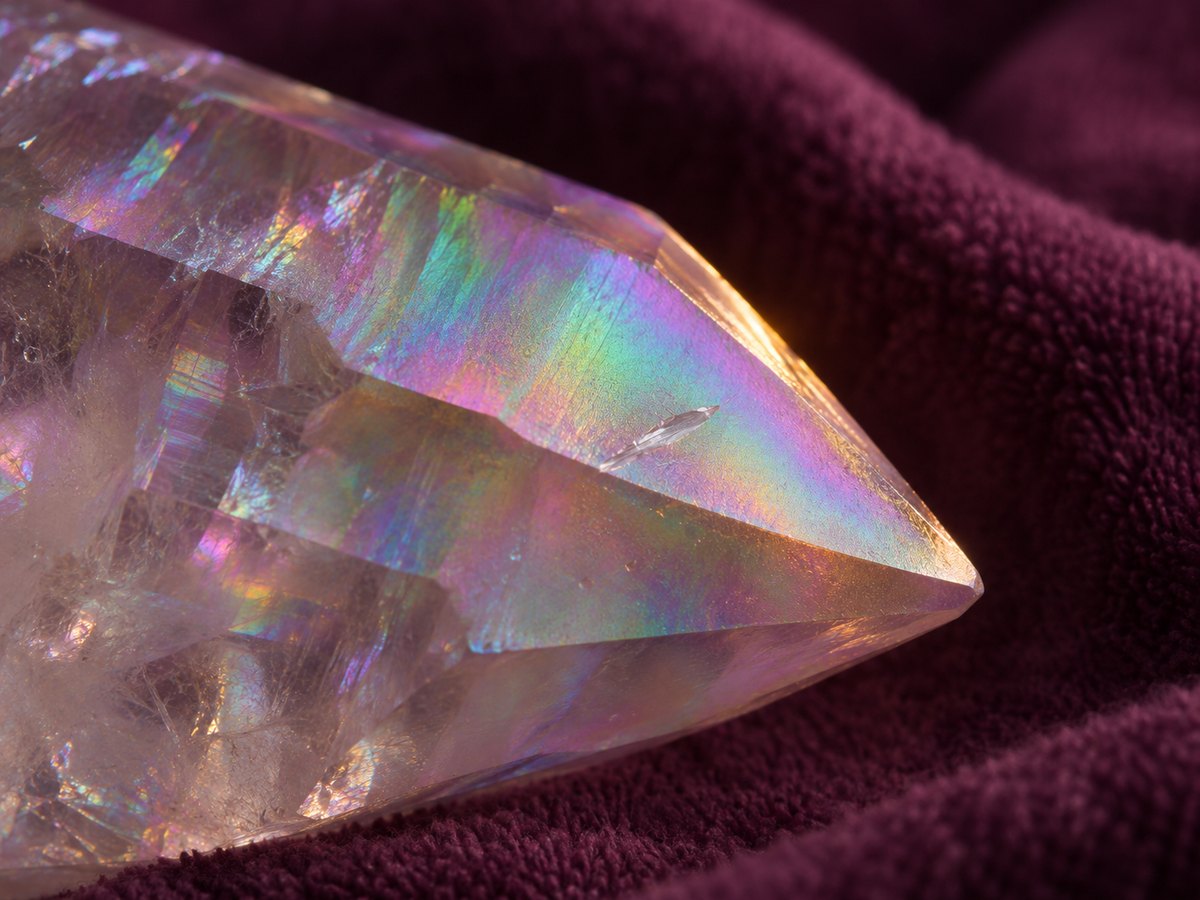
Angel aura quartz is one of the prettiest things in any crystal shop: a clear quartz point with a soft, pearly rainbow skin that shifts from pink to lilac to pale gold as you turn it. It is also one of the most misunderstood. That shimmer did not grow in the ground. It is a thin layer of metal that people put there, on purpose, in a machine.
None of that makes it a fake. The crystal underneath is real quartz, and knowing how the coating is made helps you buy well and look after it.
What angel aura quartz actually is
Angel aura quartz is natural clear quartz with a very thin metal coating on its surface. It is also sold as opal aura or rainbow aura. According to the Wikipedia entry on metal-coated crystals, these are artificial products made by coating crystals such as quartz with metal to give them an iridescent metallic sheen, and the coatings can include gold, indium, titanium, niobium and copper.
The angel aura look first reached gemologists in 1990. The Winter 1990 issue of Gems & Gemology, the GIA journal, reported a new enhancement sold as "Rainbow" quartz. According to the vendor's own literature quoted there, it was made by bonding silver and platinum to the crystal, and the journal's index lists it as quartz "with silver-platinum coating." GIA noted one key difference from its gold-coated cousin: the rainbow version shows strong surface iridescence but does not change the apparent body color of the quartz. That is exactly the angel aura look: a crystal that still reads as clear or milky white, with rainbows dancing on top.
Aqua aura: the gold-coated sibling
Aqua aura came first. The Winter 1988 Gem News column in Gems & Gemology described rock crystal coated with a film of gold so sheer that it no longer looks like gold at all. Instead you see the color gold passes in transmitted light, a blue to greenish blue. GIA reported it was being promoted under the name "Aqua Aura" by Bob Jackson Minerals of Renton, Washington, and that the editors' testing found the coating did not change the measured properties of the quartz underneath.
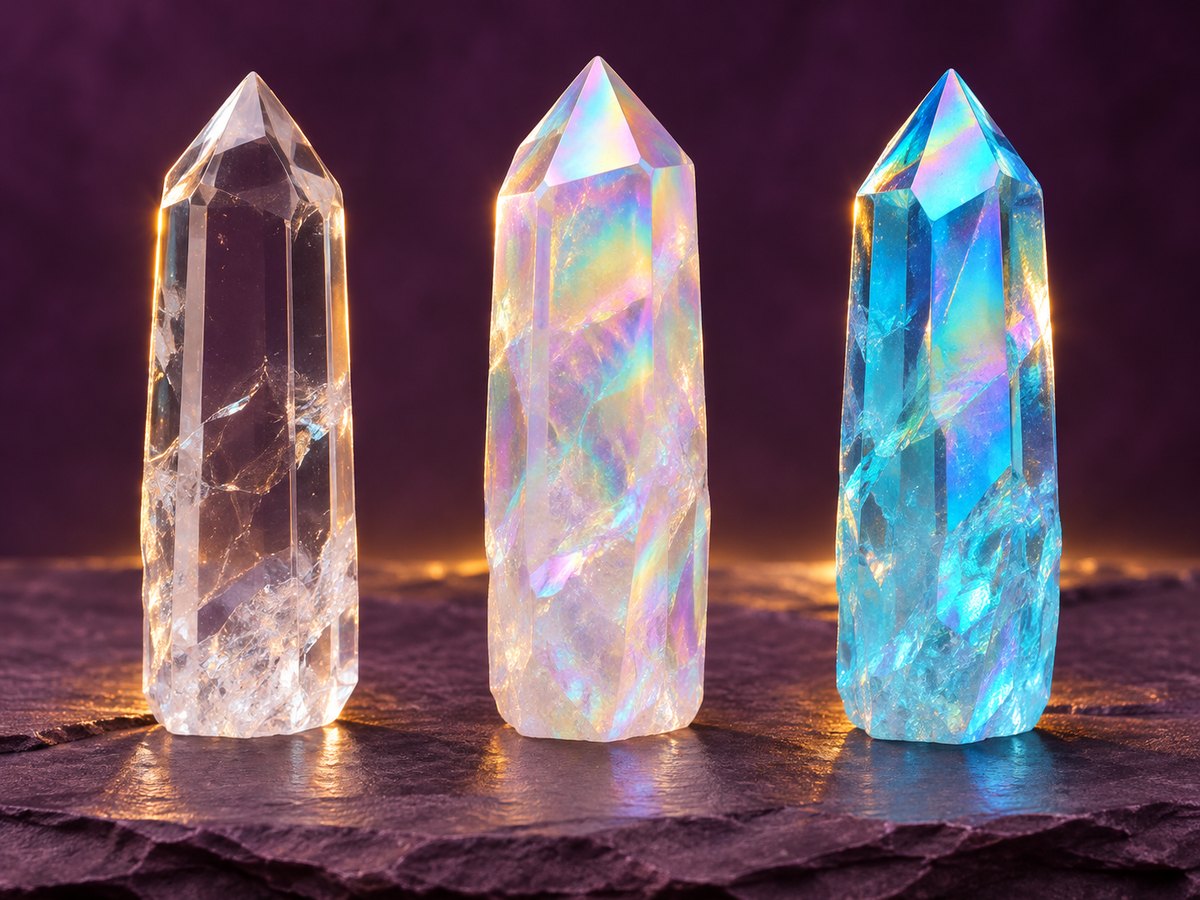
So the simple rule is: angel aura is silver and platinum, pale and pearly; aqua aura is gold, a vivid electric blue. Both are real quartz with a human-made finish.
How the coating is made
The process is called vapor deposition, the same broad family of techniques used to put thin films on optics and electronics. According to the Wikipedia entry on metal-coated crystals, the quartz is heated to about 871 °C (around 1,600 °F) inside a vacuum chamber, while a metal wire is heated even hotter. The metal turns to vapor and settles onto the crystal's surface as an extremely thin film.
The colors are not pigment; they come from light playing off an extremely thin film. A 1989 study in The Journal of Gemmology, which examined an aqua aura crystal from the GIA collection, traced the technology to the thin-film gold coatings used on astronauts' helmet visors. The same study found the coating uneven in places: thicker near the crystal edges, missing from some small areas, and poorly deposited inside surface pits. Chemical testing found silicon and gold, as the vendor claimed, and also titanium.
Because the metal layer is so thin, there is very little precious metal in any aura crystal. You are paying for the quartz, the treatment and the craft, not for an ounce of platinum or gold.
How to tell real from fake
"Real" angel aura means genuine quartz with a vapor-deposited coating, sold honestly as coated. The things to watch for are glass dressed up as quartz, painted or dyed pieces, and sellers who claim the rainbow is natural.
- Ask for the word "coated" or "treated." An honest listing says the color comes from a metal coating. A seller who insists the rainbow formed naturally underground is the clearest red flag.
- Look at the edges and dings with a loupe. GIA's review of gem treatments in the 1990s noted that aqua aura is easily detected by unnatural coloring at the facet junctions and patchy color on some faces. The Wikipedia summary adds white abrasions and pits where the coating did not take or wore away. Small clear "windows" like these are normal on genuine coated quartz.
- Check for round bubbles. Glass is the classic quartz imitation. GIA's Spring 2003 Gem Trade Lab Notes described beads sold as a quartz variety that, under a loupe, showed numerous spherical gas bubbles and proved to be manufactured glass. Natural quartz does not contain perfectly round bubbles like that.
- Watch for dye pooling. Dyed quartz usually shows color collected in cracks rather than a shifting metallic sheen across the faces.
How to care for it (the coating can scratch)
Here is the most useful fact in this whole guide. The quartz underneath is tough, but the coating is the fragile part. In the 1989 Journal of Gemmology durability tests, a hardness point of Mohs 6 did not mark the coating, but a point of Mohs 7 left a scratch. That matters because, according to GIA's gem encyclopedia, amethyst and rose quartz are both quartz with a Mohs hardness of 7. In other words, another quartz crystal is hard enough to scratch your angel aura.
The same study found the coating stood up to acetone and to high heat. GIA's review of the 1990s described the coating as relatively hard and chemically inert, while warning that care is needed during jewelry making and repair. An earlier GIA Gem News note from 1998 added that because these layers are so thin, coated material is generally not appropriate for many jewelry uses. So the threat is friction, not water or soap.
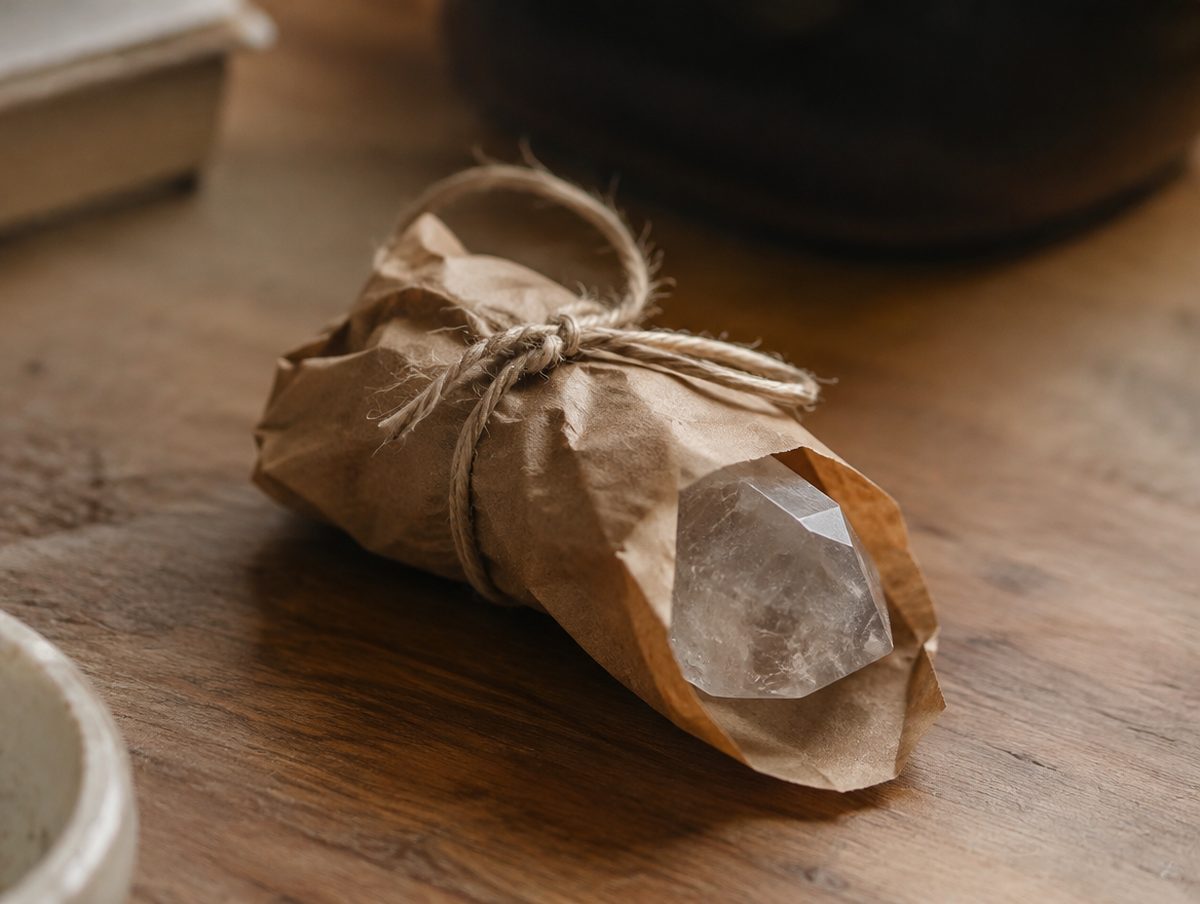
- Store it on its own. Keep each piece in a soft pouch or a lined box, never loose in a drawer or pocket with other stones or keys.
- Clean gently. Dust it, or rinse briefly in lukewarm water with a drop of mild soap and pat it dry with a soft cloth.
- Skip the harsh methods. No salt scrubs, scouring pads, polishing compounds or ultrasonic cleaners. Many crystal guides, including Beyond Bohemian's aura crystal guide, also suggest avoiding long soaks in salt water.
- Think twice about rings and bracelets. Hands and wrists take daily knocks; a pendant or a shelf piece keeps its rainbow longer.
Angel aura quartz meaning: what people believe
The meanings attached to angel aura come from modern crystal tradition, not from mineralogy. Even crystal sellers say so: Faruzo's guide notes that its associations track its name and soft, ethereal coloring rather than anything specific to quartz as a mineral, and that they are a matter of tradition and personal meaning.
Within that tradition, many people connect angel aura with calm, lightness and spiritual connection, and use it as a focus during meditation or prayer. Because the sheen mixes many colors at once, some practitioners see it as an all-chakra stone, and others link it to the crown chakra at the top of the head. Its name invites angel imagery, so people often keep it on altars or in spaces set aside for reflection.
Aqua aura carries a different set of associations. Practitioners usually link its blue to the throat chakra, and many people use it as a reminder to speak honestly and clearly.
How it pairs with other stones
In crystal tradition, popular pairings for angel aura include:
- Amethyst, for a violet and pearl palette that many people choose for a meditation corner.
- Rose quartz, a gentle pink companion often used in gift sets.
- Celestite and selenite, pale stones that practitioners pair with angel aura for a quiet, airy display.
- Clear quartz, which shows off the coating by contrast.
Aqua aura is often grouped with other blue stones such as aquamarine, amazonite and blue lace agate.
One practical note: display them together, but store them apart. Amethyst, rose quartz and clear quartz can all scratch the coating if they rub against it. Leave a little space between pieces rather than piling them in a bowl.
Angel aura also turns up in crystal jewelry and in some larger crystal pieces. iPyramids offers angel aura and aqua aura crystal line-ups across its pendants, coils and pyramid frames, which you can browse on our iPyramids collection page.
Choosing your first piece
Start with what draws your eye. Look for an even sheen with few bare patches, a clean point and a seller who names the coating and the metals used. Then give it its own soft pouch the day it comes home.
Quick answers
Is angel aura quartz real or fake?
The crystal is real quartz. The rainbow sheen is a thin coating of silver and platinum added by vapor deposition, so the color is human-made. An honest seller will describe it as coated or treated quartz. The real fakes are glass imitations and pieces sold as naturally rainbow-colored.
What is the difference between angel aura and aqua aura quartz?
Angel aura is coated with silver and platinum and stays clear or pearly white with pastel rainbow flashes. Aqua aura is coated with gold, and the thin gold film makes the crystal look vivid blue to greenish blue. Both start as natural clear quartz.
Can angel aura quartz get wet?
A brief rinse in lukewarm water with a drop of mild soap is fine, because the coating is bonded to the crystal. The danger is friction, not water. Avoid salt scrubs, scouring pads, ultrasonic cleaners and long salt-water soaks, and pat it dry with a soft cloth.
Why does my angel aura have small clear spots?
Gemologists have documented that the coating is often uneven, thinner or missing on edges, in pits and where the piece has been knocked or rubbed. Small clear windows are normal on genuine coated quartz. Store each piece in its own pouch to keep new scratches from forming.