No single home trick proves a stone is genuine. But a handful of simple, gentle checks, done together, will catch most glass, plastic, dyed and treated look-alikes.
First, what does "real" mean?
A stone can be "real" in more ways than people expect. Sort what you hold into four groups:
- Natural and untreated: the mineral exactly as it formed, just cut or polished.
- Natural but treated: a real mineral whose color or look has been changed by heat, dye, filling or a coating.
- Lab-grown: the same mineral made in a laboratory. EarthWonders, a mineral dealer, points out that lab-grown quartz is still real quartz and will pass every home test.
- Imitation: a different material, such as glass, plastic, resin or a dyed cheaper stone, made to look like something it isn't.
As Chalmers Gems, a gemstone dealer with over 25 years in the trade, puts it, the real question usually isn't "is it real?" but "is it what I was told it was?" A treatment isn't a scam; hiding it is.
In the US, the Federal Trade Commission's Jewelry Guides set the rules here. According to the FTC's "In the Loupe" guidance, an imitation should be described as "imitation" or "simulated" right before the stone's name, a lab-created stone should say so just as clearly, and a treatment should be disclosed if it is not permanent, needs special care, or significantly affects value.
How to tell if a crystal is real: 6 gentle home tests
Start with the tests that can't hurt the stone. Every result is a clue, not a verdict.
1. The temperature test
Quartz and most natural stones draw heat away from your skin faster than glass or plastic. EarthWonders explains the trick: don't hold the stone first, because your hand warms it. Leave it next to a known piece of glass, such as a marble, for about an hour, then touch each to your lip or inner wrist. Quartz feels properly cold and stays that way; glass feels cool for a second and then warms up. You can also breathe on both at once, and the fog clears faster from quartz. Use pieces walnut-sized or bigger.
2. Look inside with a 10x loupe
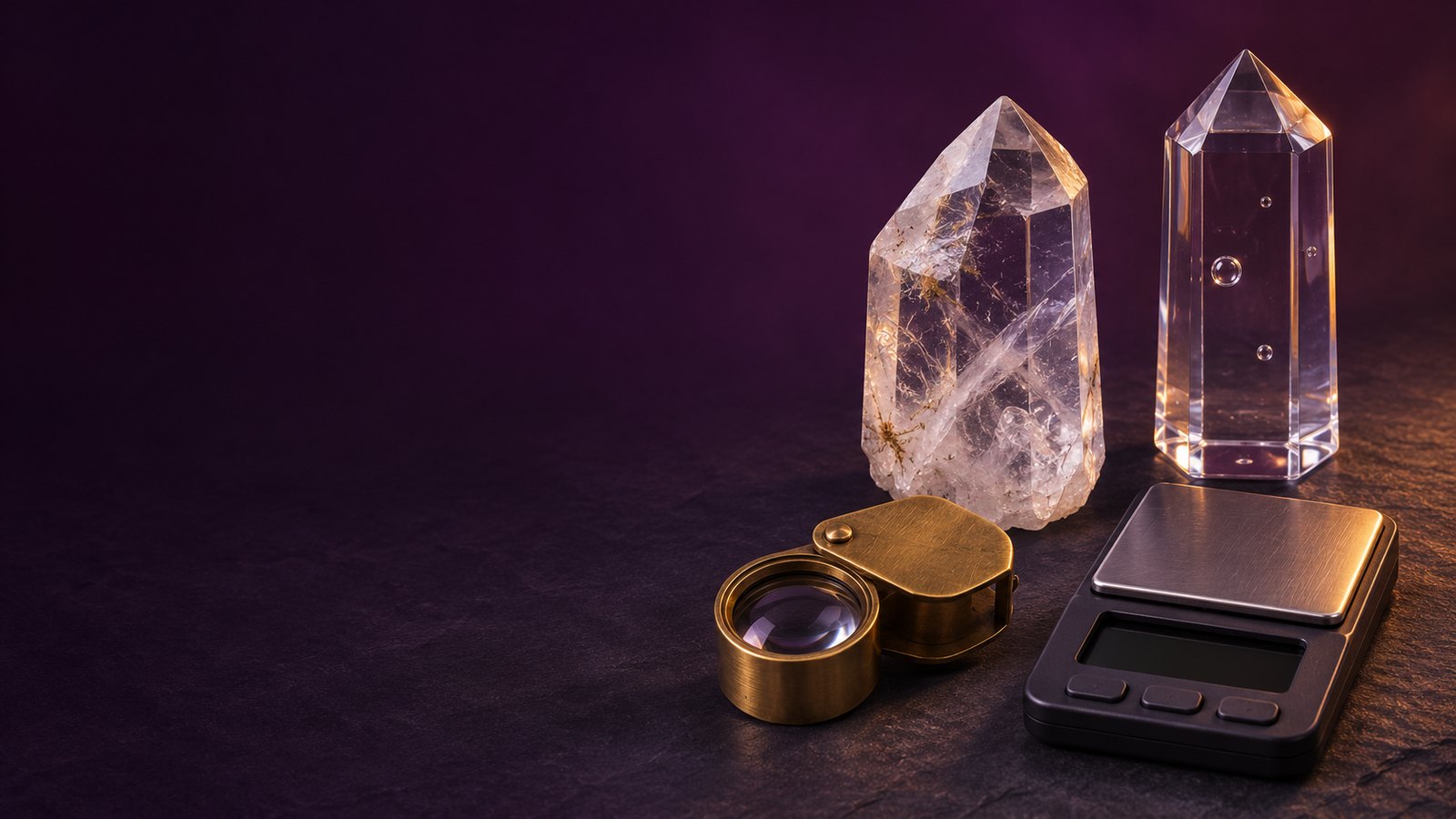
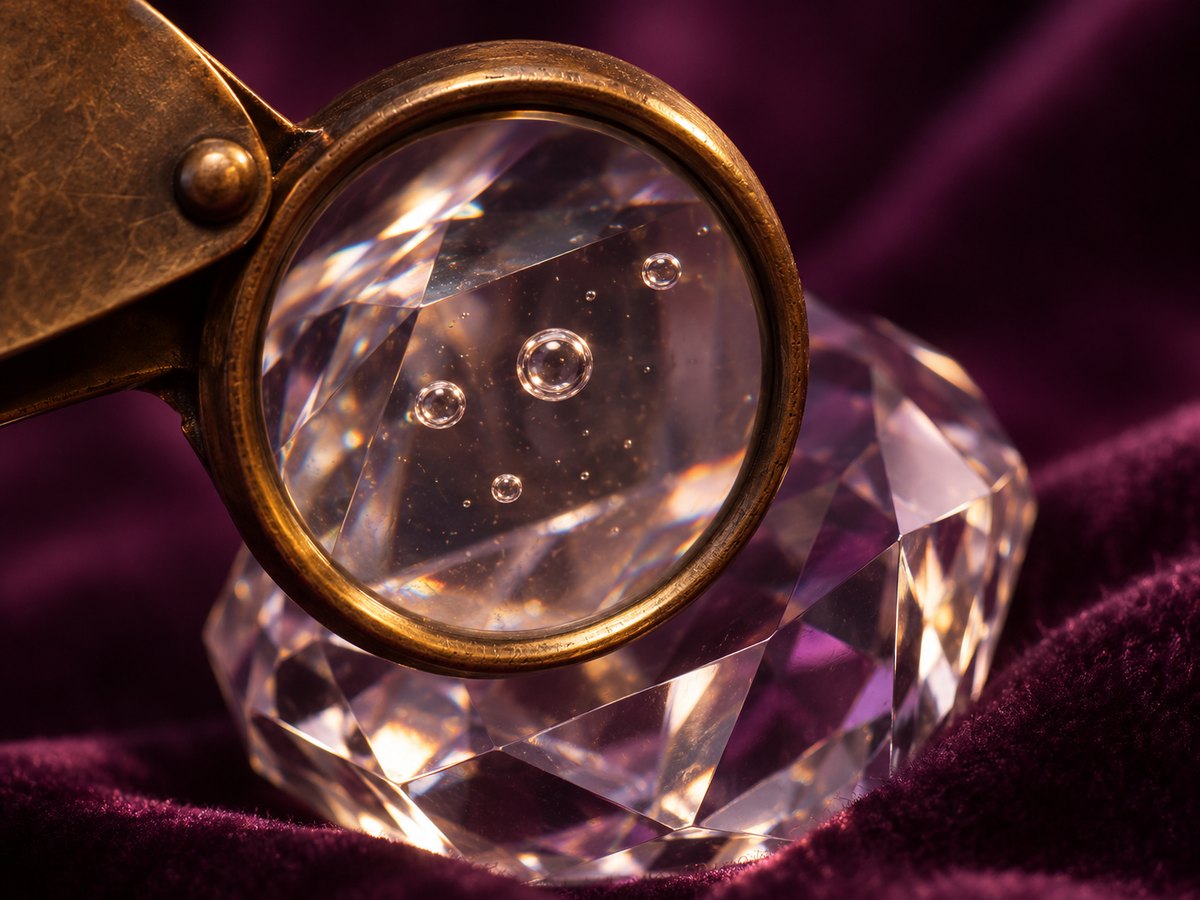
According to EarthWonders, glass usually shows perfectly round bubbles, like tiny pearls frozen in place, and sometimes swirly lines like honey stirred into tea. Natural quartz instead tends to show irregular inclusions trapped as it grew. But real quartz can hold trapped liquid with a moving bubble, and modern glass is often bubble-free, so neither a bubble nor a clean stone proves anything alone.
3. Check the shape and surface
If your piece still has its natural faces, look closely. EarthWonders notes that natural quartz grows as a six-sided column with a pointed tip, often with fine horizontal lines called striations across the long sides, plus small steps or a rough, broken base. Chalmers Gems adds one of the most decisive clues of all: a mold seam, a fine line around the widest part of a bead or cabochon, or inside a drill hole, where two halves of a mold met. Natural stone is cut and ground, not poured, so a seam means glass, plastic or resin.
4. Feel the weight
Chalmers Gems calls this "hefting." Plastic and resin imitations feel conspicuously light for their size, while some leaded glass feels heavier than the stone it imitates. Be careful with quartz versus ordinary glass, though: EarthWonders says that difference is far too small to feel by hand. For that, there is a kitchen-scale version.
5. Weigh it in water (specific gravity)
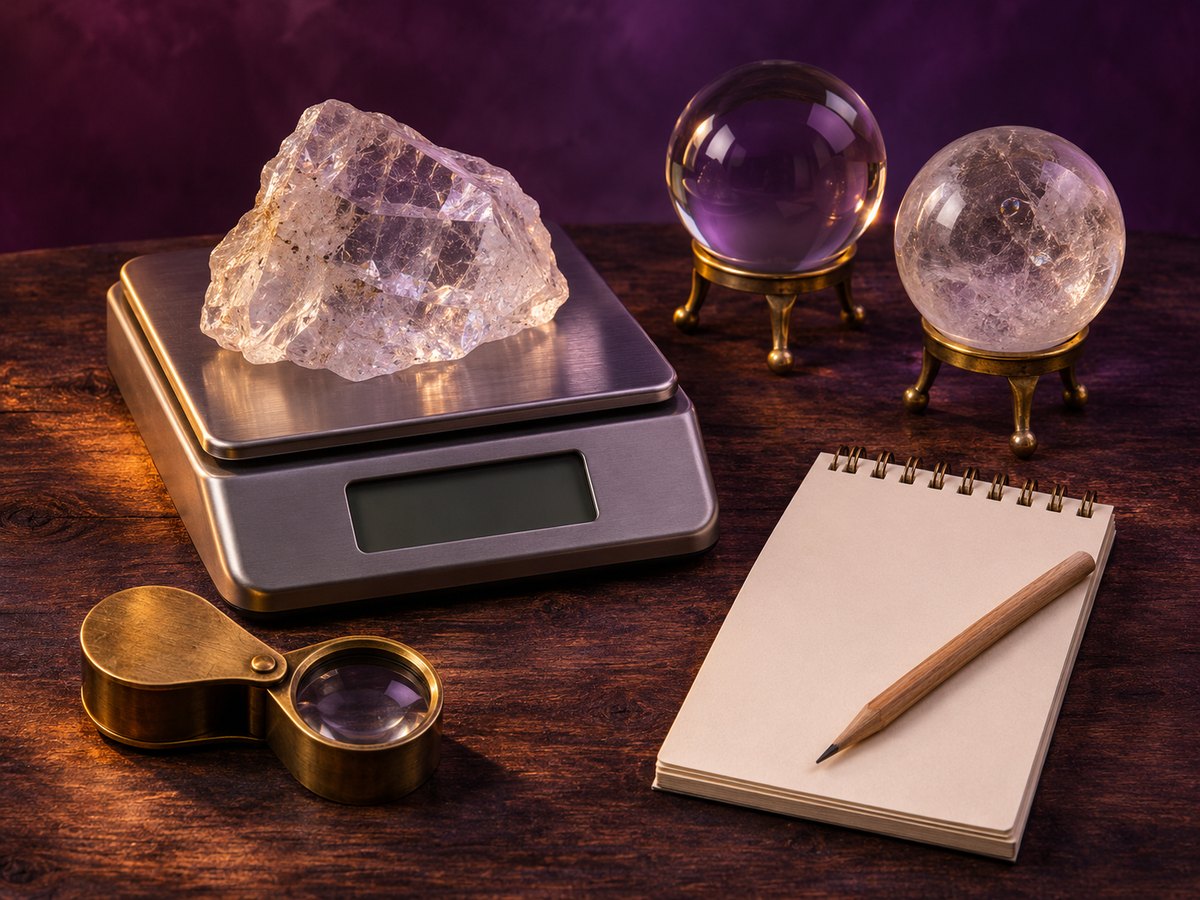
Weigh the stone dry, then weigh it hanging fully under water on a thread without touching the container, and divide the dry weight by the difference. Per EarthWonders, quartz comes out at about 2.65, ordinary glass about 2.4 to 2.5, heat-resistant glass about 2.2, and leaded glass 2.9 or more. Brush off clinging air bubbles first.
6. The scratch test, only if you must
Quartz is harder than ordinary glass, so it can scratch a glass bottle, but glass can't scratch quartz. Geology.com's guide to the Mohs scale lists quartz at a reliable 7 but warns that glass varies from 4 to 7, knife blades from 5 to 6.5 and streak plates from 5 to 7, so test your tools before you trust them. EarthWonders adds sensible rules: use a hidden spot, never a polished face or cut gem; a white line that wipes off is powder, not a scratch; and never tap or strike a stone, because hard is not the same as tough.
The most common fakes, and how to spot them
Glass sold as quartz
Clear glass points and spheres are the most common swap. Run the temperature, loupe and water tests above, and read our clear quartz guide for more. Watch, too, for trade names that sound like stones but are glass, such as "opalite": Chalmers Gems lists opalite, with its milky blue tint, as a common imitation of moonstone.
Dyed howlite or magnesite sold as turquoise
According to a 2024 article in GIA's journal Gems & Gemology, turquoise is often imitated by dyeing common, inexpensive minerals such as howlite or magnesite. Chalmers Gems says the clue is dye pooling in the veins. Look with your loupe for color concentrated in cracks and dark lines.
Heated amethyst sold as natural citrine
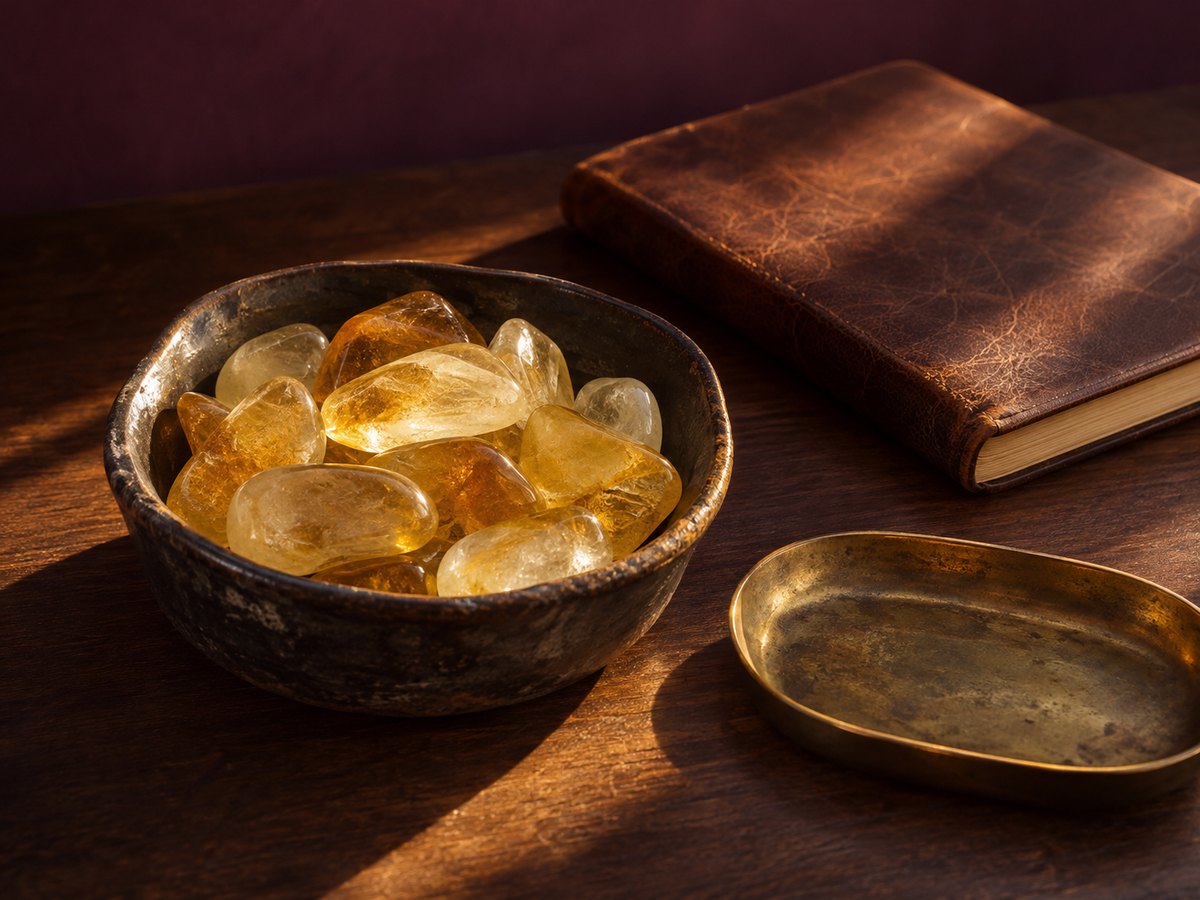
GIA states plainly that natural citrine is rare and that most citrine on the market is heat-treated amethyst. Geology.com describes the giant "citrine" geodes from Brazil: when found, most are full of purple amethyst, and they are heated in industrial ovens to turn them orangy brown. Wikipedia's quartz article notes heated amethyst turns yellow-orange, orange, red or brown. This is a treatment, not a fake, but it should be labeled. Our citrine meaning guide covers how to tell the difference, and our amethyst guide explains where that purple starts.
"Goldstone"
Goldstone, with its sparkling copper glitter, is often sold beside crystals. According to Wikipedia's article on goldstone, it is a type of glass, also called aventurine glass, whose glitter comes from tiny copper crystals. It is lovely and perfectly fine to own; just know it is glass, not a mined stone.
Resin and plastic
Resin "crystals," especially bright colors and perfect shapes, feel light, warm quickly in the hand and may show mold seams or bubbles.
Coated "aura" crystals
EarthWonders notes that aura quartz is real quartz with a thin metallic coating. It isn't fake, but the rainbow is added. See our angel aura quartz guide.
Price and seller red flags
- Too big, too bright, too cheap. A large, vivid piece labeled "natural citrine" at a bargain price is almost certainly heated, since GIA calls natural citrine rare.
- Perfect uniformity. Bags of identical, flawless, neon-colored stones suggest dye, glass or resin.
- Vague labels. "Crystal," "quartz crystal" or "faux" with no detail. The FTC says "faux" is not an adequate disclosure for an imitation.
- Made-up names. Trade names that sound like minerals but don't appear in any mineral reference.
- No answers. Ask where it was mined and whether it has been heated, dyed, coated or filled. A good seller answers plainly.
Crystal identification: when to ask a professional
Home tests narrow things down; they can't settle everything. For a costly piece, or any time the tests disagree, take it to a qualified gemologist or a gem laboratory. Labs have tools no home kit can match. GIA's 2024 overview of infrared spectroscopy, for example, notes that FTIR readings clearly tell turquoise from dyed howlite and magnesite and reveal polymer resin fillers that are hard to see under a microscope.
Safety while you test
- Don't lick or taste stones. EarthWonders notes the "lick test" tells you nothing the cold test doesn't, and some minerals and dyes shouldn't go near your mouth.
- Wash your hands after handling raw or dyed pieces.
- Be gentle with treated stones. Coatings scratch and dyes can bleed, so skip harsh cleaners and soaking.
Once you know what you own, you can enjoy it fully, whether that is a rough quartz point, a heated citrine geode, or a piece of sacred geometry from the iPyramids harmonizer collection.
Quick answers
What is the easiest way to tell if a crystal is real?
Start with a 10x loupe and a temperature check. Glass often shows perfectly round, frozen bubbles, and it warms up in your fingers faster than quartz. Neither test is proof on its own, so combine them with the shape, weight and water tests.
Do real crystals have bubbles?
They can. Natural quartz sometimes holds trapped liquid with a small moving bubble. Glass bubbles tend to be perfectly round and frozen in place. And modern glass is often bubble-free, so a perfectly clean stone doesn't prove it is real.
Is heat-treated citrine fake?
It is real quartz, but its color comes from heating amethyst rather than from nature. GIA says most citrine on the market is made this way. It is a treatment, not an imitation, and a good seller should label it.
How can I tell if turquoise is dyed howlite?
Look with a loupe for dye pooling in the cracks and veins. For a costly piece, a gem lab can tell turquoise from dyed howlite or magnesite with infrared testing.