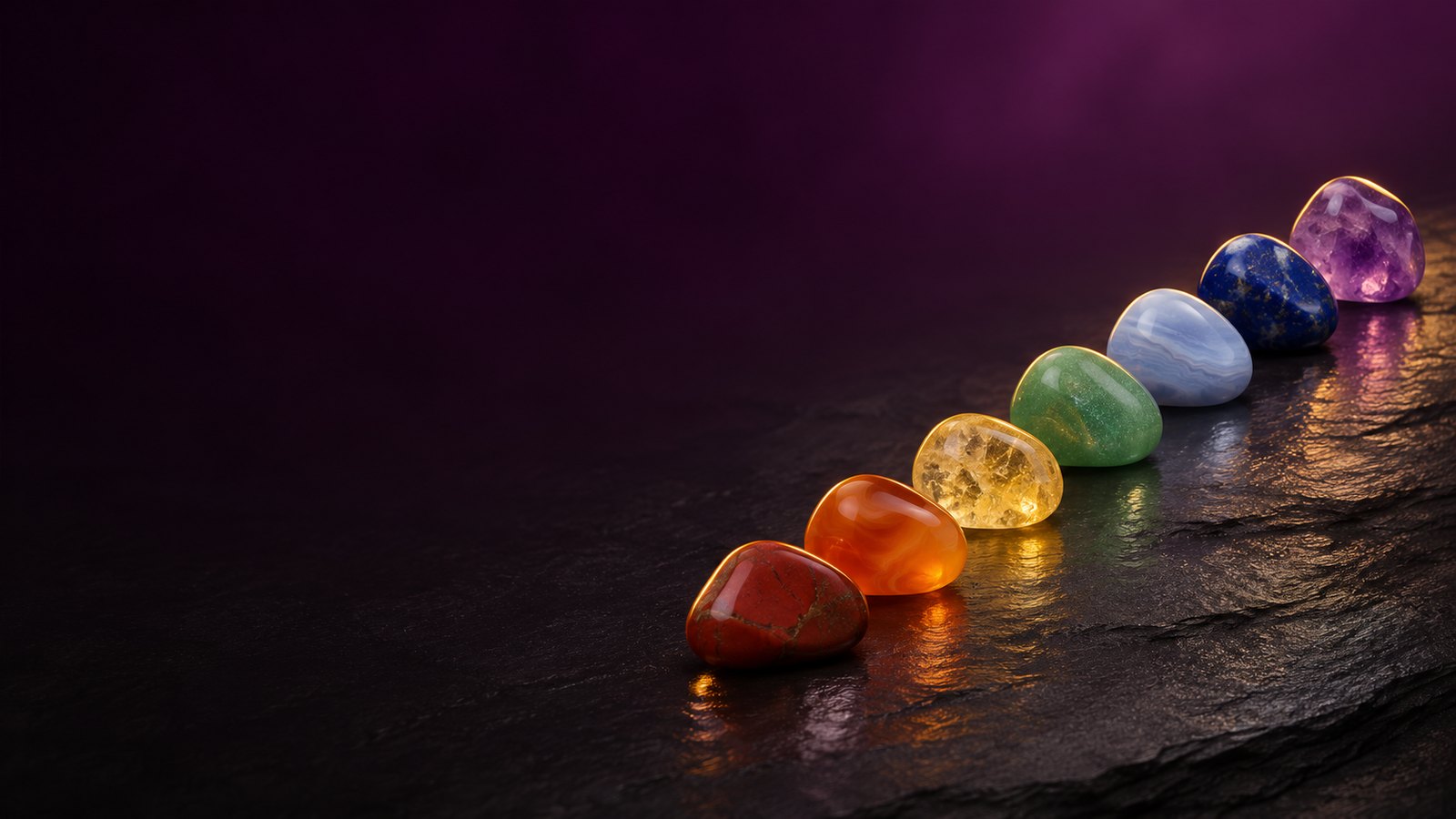
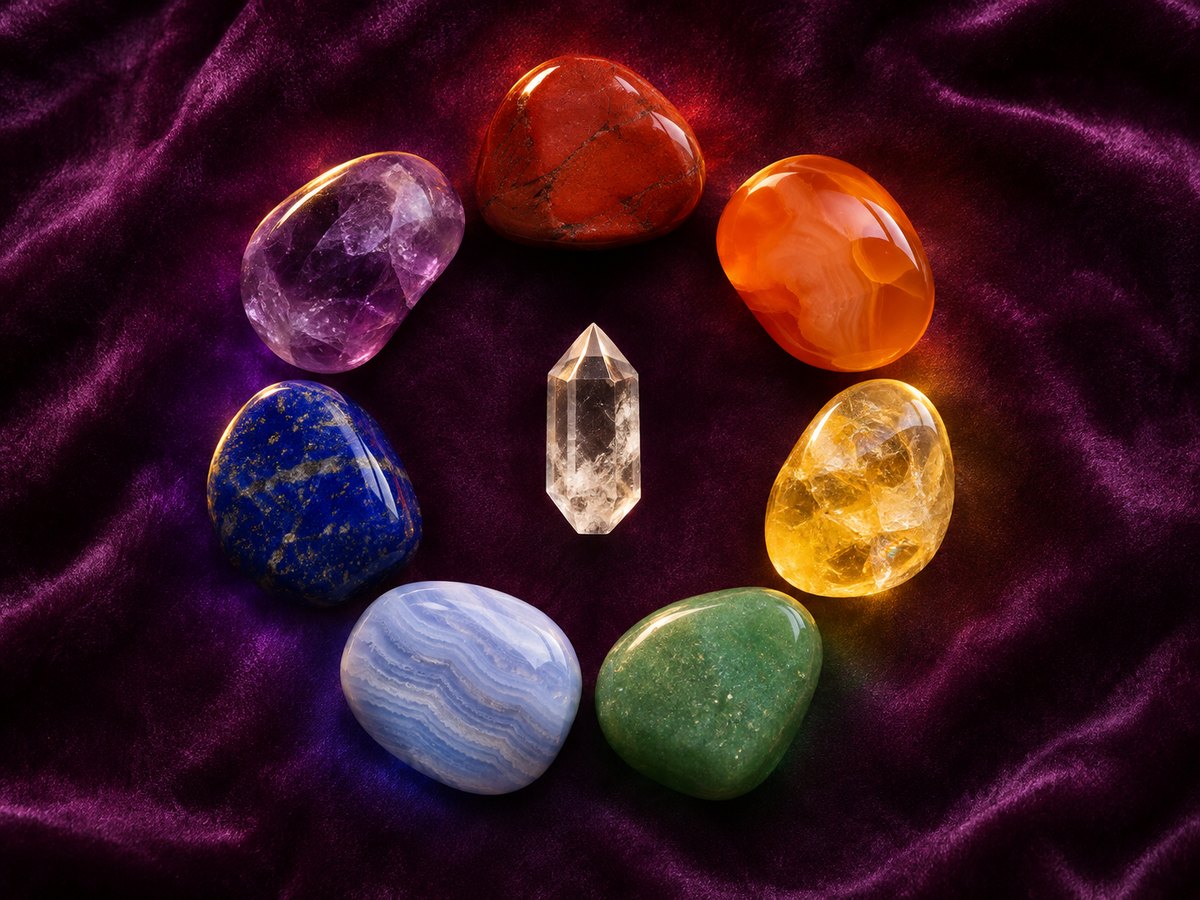
Chakra stones are crystals matched by color to the seven energy centers of the modern chakra system, red at the base of the spine up through violet at the crown. Lay a set in a line and it looks like a rainbow, which is exactly the idea. Many people use them as a simple, hands-on way to focus a meditation from one center to the next.
Here is where the system comes from, which stones people pair with each chakra, why the lists don't always agree, and how people use chakra stones with sound. Everything here is tradition and belief, offered as such.
What the chakras are, in tradition
The word comes from Sanskrit. According to Wikipedia's well-sourced entry on the chakra, cakra means "wheel" or "circle," and chakras are visualized in Hindu and Buddhist tantric yoga and meditation as centers of a subtle, spiritual body. They are a meditation aid, not organs you could find on a scan.
The number has varied. The same entry notes that medieval Buddhist texts mention four or five chakras and Hindu sources use various numbers. The most familiar version, with seven, reached the West through the 1919 book The Serpent Power by "Arthur Avalon," a translation of a Sanskrit text from 1577.
The rainbow came later still. Wikipedia's timeline places the rainbow colors for the seven chakras in the 1930s, and notes that this New Age version uses the Newtonian colors of the rainbow, which are not found in any ancient Indian system. Gemstone pairings were added after that, as part of a broad set of modern correspondences. So chakra stones are a modern Western practice built on an old idea, and that is the honest way to enjoy them.
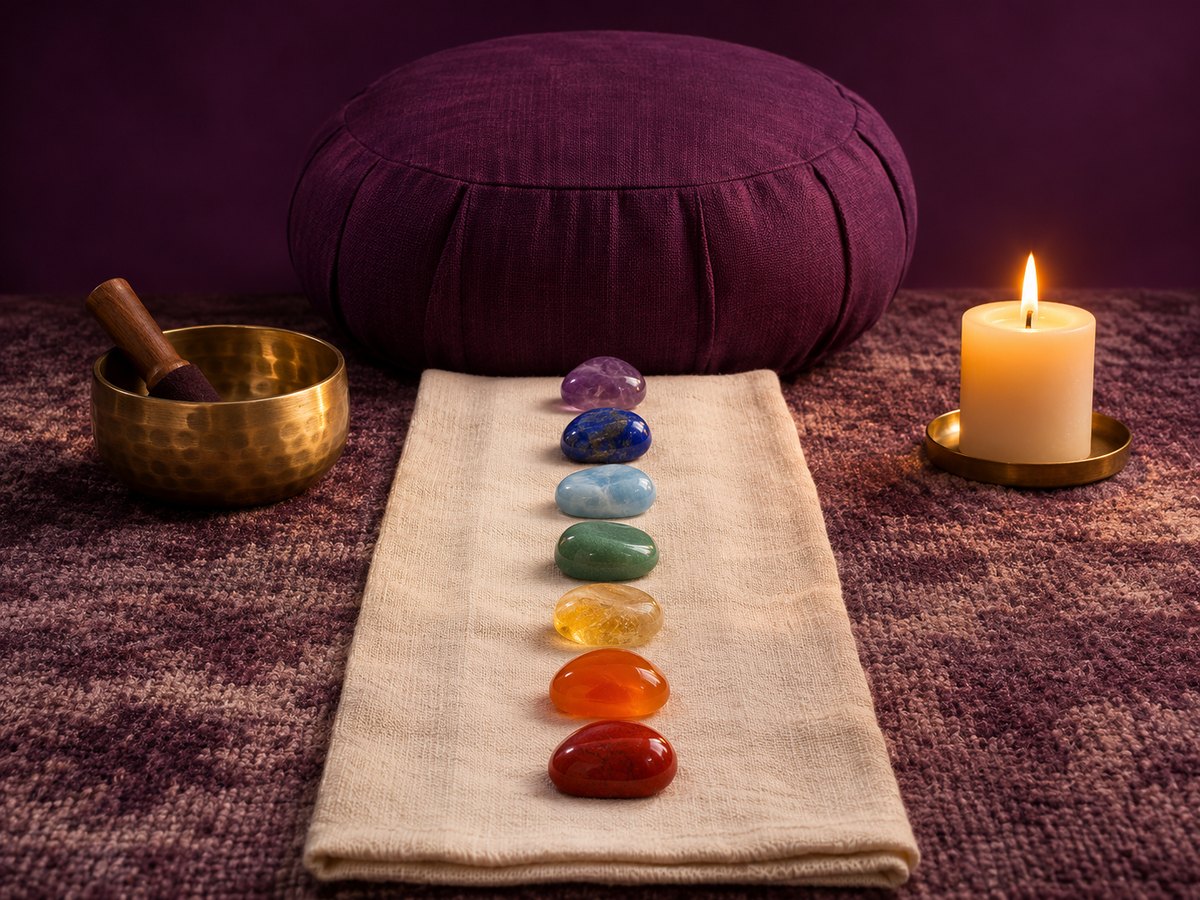
Chakra stones by color: the seven chakras
The pairings below follow the lists published by Fire Mountain Gems, a long-running bead supplier whose gemstone guides record common crystal lore, plus the stones most often seen in chakra sets. Locations are as practitioners describe them.
1. Root chakra (Muladhara) · red
At the base of the spine. Practitioners link it with feeling grounded, safe and steady. Fire Mountain Gems ties red garnet to the root chakra, and dark, earthy stones are the classic picks: black tourmaline, obsidian, hematite, smoky quartz and red jasper.
2. Sacral chakra (Svadhisthana) · orange
Just below the navel. In tradition it is the center of creativity, pleasure and emotion. Fire Mountain Gems lists carnelian and sunstone, and orange calcite often appears in sets.
3. Solar plexus chakra (Manipura) · yellow
Above the navel. Linked with personal power, confidence and will. Fire Mountain Gems lists amber, citrine, yellow calcite and tiger's eye.
4. Heart chakra (Anahata) · green, sometimes pink
The center of the chest. Practitioners connect it with love, compassion, trust and forgiveness. Fire Mountain Gems lists amazonite, aventurine, jade, malachite, peridot, rhodonite, rhodochrosite and rose quartz. Our green aventurine guide and green crystals guide go deeper on the green ones.
5. Throat chakra (Vishuddha) · light blue
At the throat. Linked with communication, listening and speaking your truth. Fire Mountain Gems lists aquamarine, blue lace agate, turquoise and sodalite.
6. Third eye chakra (Ajna) · indigo
Between the brows. Linked with intuition, imagination and inner guidance. Fire Mountain Gems lists lapis lazuli and sodalite, and many sets use amethyst or labradorite here.
7. Crown chakra (Sahasrara) · violet or white
At or just above the top of the head. In tradition it stands for spiritual connection. Fire Mountain Gems lists amethyst and crystal quartz, and clear quartz is often called an all-chakra stone.
Why chakra lists don't always agree
If you compare two chakra charts, you will find differences. Sodalite sits at both the throat and the third eye in Fire Mountain Gems' own lists. Some teachers put lapis lazuli at the throat because of its blue, others at the third eye. Rose quartz is a heart stone in most charts, yet some makers place it at the crown.
That is normal for a living, modern tradition with no single rulebook. A good approach is to choose a chart you like and stay with it, or simply follow color: the stone that looks right for a center is, for your practice, the right stone.
How people use chakra stones
- A lying-down layout. The most popular practice: lie on your back and place one stone on or beside each center, root to crown. Many people breathe slowly and move their attention up the line, one color at a time, for ten to twenty minutes.
- A focus stone. Some people work with one chakra at a time, holding a single stone during meditation or keeping it on a desk as a reminder.
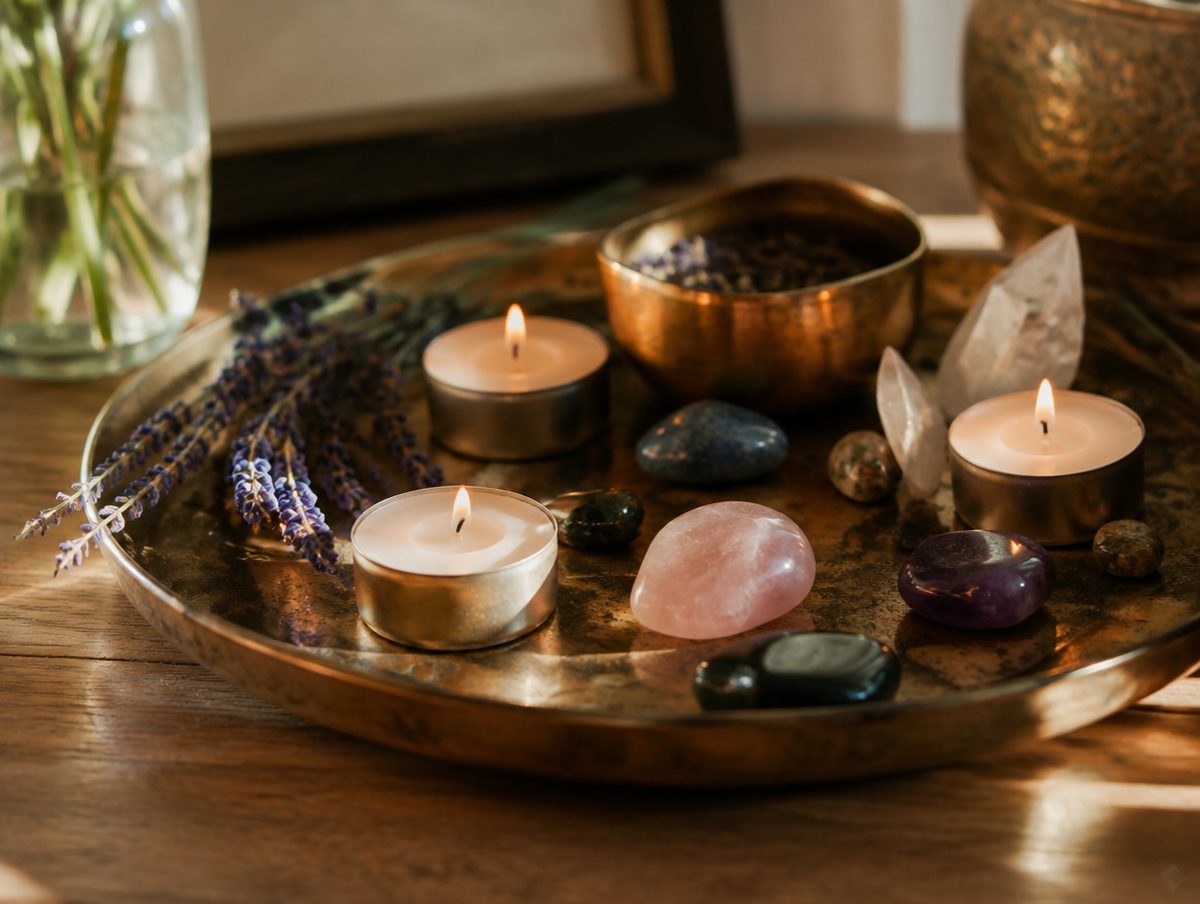
- A chakra set on an altar. Seven small tumbled stones in a row make a simple, colorful centerpiece. Our guide to building a meditation altar shows how to lay one out.
- Jewelry. Chakra bracelets with one bead per center are a common way to carry the whole set.
Pairing chakra stones with sound
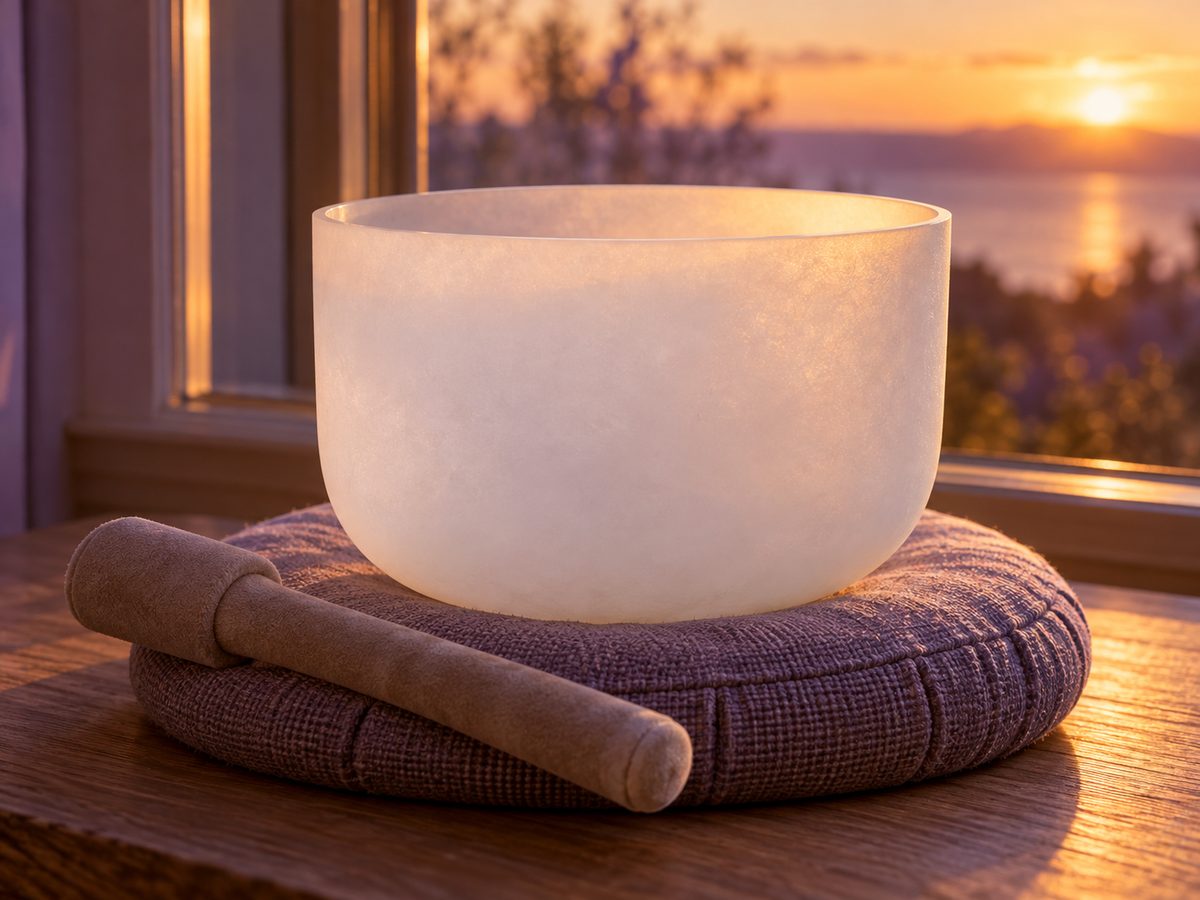
Sound is the other half of many chakra practices. The crystal singing bowls in our bowl room include a chakra set from Resonance Reset, tuned to 432 Hz, that runs up the scale from the Root bowl at C4 to the Crown bowl at B4, with a Soul Star bowl at C5 above it. Each bowl is paired by its maker with a gemstone, from obsidian at the root to rose quartz at the crown, so the stone and the note share a center. You can hear every bowl before you buy, and see them all in the Bowl Shop.
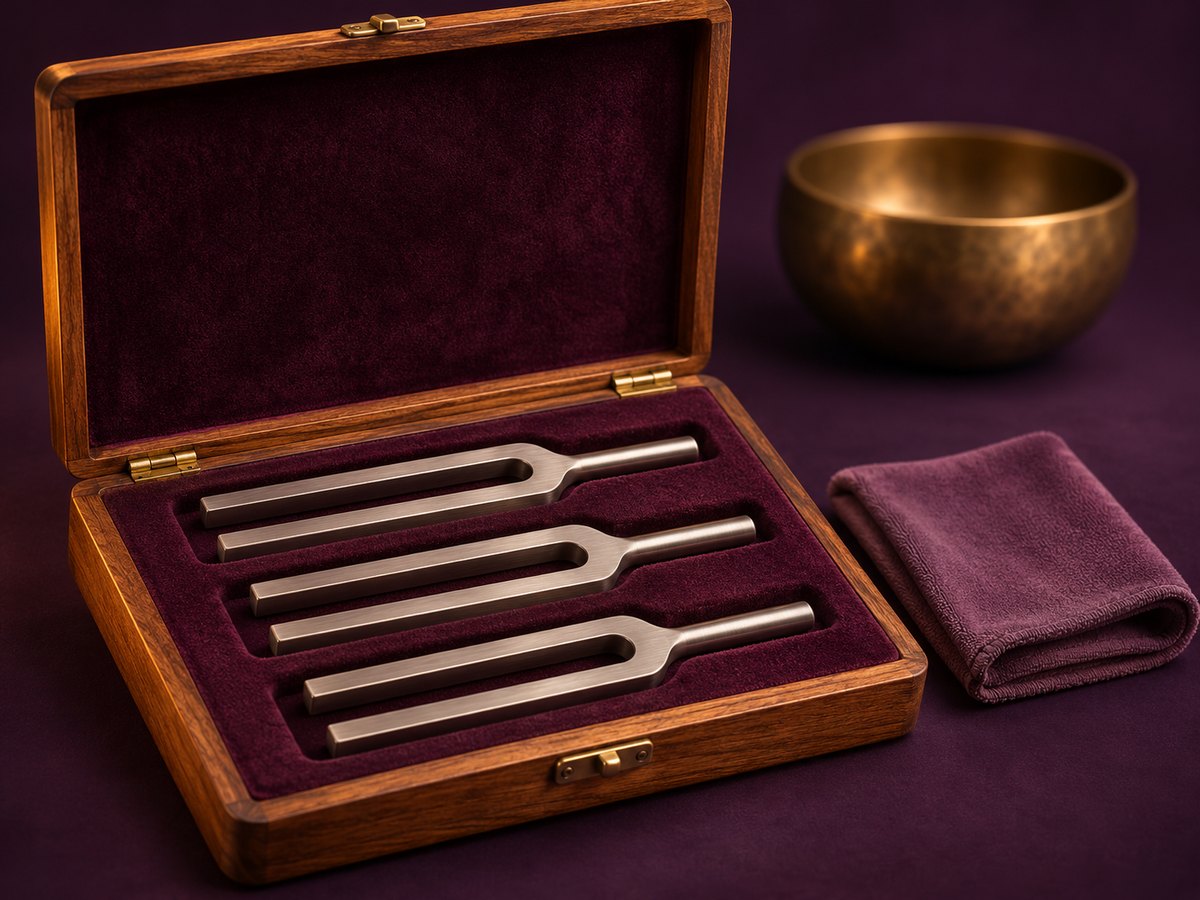
Tuning forks are another option. Our tuning forks guide explains the classic eight-fork chakra octave. iPyramids makes a chakra tuning-fork set too, the Sound Swords, starting at C 256 Hz, listed with their other sound tools on our iPyramids page. The same page shows a large seven-chakra orgonite pyramid, a striking altar piece.
Caring for a chakra stone set
A chakra set mixes very different materials, so one cleaning method does not fit all.
- Quartz-family stones (amethyst, citrine, clear and smoky quartz, carnelian, aventurine) handle a brief rinse in lukewarm water and a soft cloth.
- Obsidian is glass. Geology.com describes it as a volcanic glass that breaks with very sharp edges, so check raw pieces for chips before laying them on the body.
- Lapis lazuli is a rock, not a single mineral. According to GIA, it is an aggregate of lazurite, calcite and pyrite. Keep it dry and away from acids and harsh cleaners.
- Malachite needs extra care. The International Gem Society notes that malachite dust is toxic to breathe. Never sand or polish it at home, and keep it out of any water you drink.
- Store them apart. Harder quartz will scratch softer stones, so give each stone its own pouch or a divided box.
For full details, see our guide to water-safe crystals.
Who should be careful
Small tumbled stones are a choking hazard for babies, young children and pets, so put a set away after a layout. If lying flat is uncomfortable for you, a seated meditation with one stone in your hand works just as well. And chakra work is a spiritual practice: it is never a substitute for a doctor, a counselor or other professional care.
Quick answers
What are the seven chakra stones?
A typical set uses one stone per color: red jasper or garnet for the root, carnelian for the sacral, citrine for the solar plexus, green aventurine or rose quartz for the heart, blue lace agate or sodalite for the throat, lapis lazuli for the third eye, and amethyst or clear quartz for the crown. Lists vary by teacher.
Are chakra colors from ancient India?
The chakra idea is old and comes from Hindu and Buddhist tantric meditation, but the rainbow color scheme is modern. It was added in the West in the 20th century, and the gemstone pairings came later still, as part of New Age practice.
How do you use chakra stones?
The most common practice is a lying-down layout: one stone on or beside each center, root to crown, while you breathe slowly and move your attention up the line. People also carry a single stone, wear a chakra bracelet or arrange a set on an altar.
Can chakra stones go in water?
Some can and some can't. Quartz-family stones like amethyst, citrine and carnelian handle a brief rinse. Keep lapis lazuli, malachite and other soft or mixed stones dry, and never put malachite in drinking water.